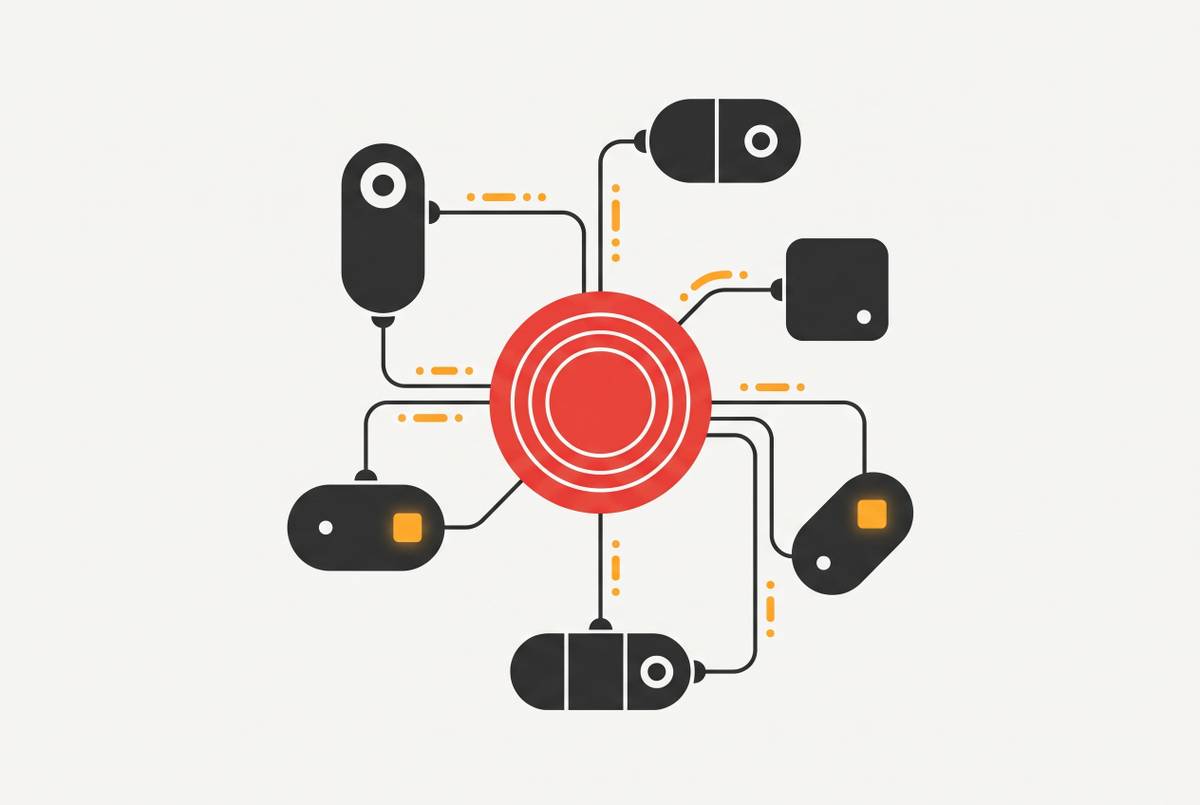
Evaluating Brand Context Bridging Software Against the Actual Architecture of a Scaled Creative Workflow
Shared, versioned brand context is what separates infrastructure from shortcuts.

For AI agents to use existing brand guidelines and systems, they need a shared, versioned context layer that turns brand identity into instructions for each task and supports evidence-based review. Brand context bridging software should be evaluated against that architecture. The decisive distinction is whether every agent draws from governed brand infrastructure or works from a separate, session-bound copy.
Why scaled creative workflows break brand consistency before they break anything else
Context fragmentation starts when agents work in parallel with brand instructions that are kept up to date separately. An email agent and an ad agent can produce polished work while disagreeing on terminology, tone, and visual treatment. The failure sits between them, because no common source determines which standards govern the campaign.
Prompt engineering can improve one output without resolving this structural gap. A revised instruction in one session remains invisible to the next agent, while separately maintained prompts turn every brand change into a redistribution task. Production can therefore continue at speed even as the campaign loses coherence.
Vera V. Vishnyakova’s 2026 paper, Context Engineering: From Prompts to Corporate Multi-Agent Architecture, frames context as the agent’s operating system. Its discussion of Klarna illustrates a contextual and intentional deficit, in which technical capability does not compensate for implicit corporate intent. The distinction is consequential for brand operations. Guidelines can fail to resolve ambiguity, review queues can become too costly to scale, and static standards can decay as circumstances change. Those failures establish five production demands, namely shared context delivery, versioned updates, task-to-brief translation, multi-agent consistency, and evidence-based review.
How do existing brand guidelines become usable by AI agents?
Brand context bridging is the architectural layer between authoritative identity data and the agents that act on it. It translates documentation into governed meaning that agents can query reliably. Storage alone does not perform that translation. A digital asset management system can hold approved files, and a generation tool can make content, while neither gives agents a shared way to interpret brand identity.
The context layer gives each part of that interpretation a defined role. Semantic definitions encode what “on-brand” means in machine-executable terms, while entity resolution keeps logos, typefaces, colors, and voice rules consistently identified across tools. Governance restricts permitted uses of those resources. Lineage traces how an asset was produced, and memory preserves earlier decisions so that each task need not begin from nothing.
For a brand team, the architectural test is straightforward. A guidelines PDF uploaded into one chat window does not become infrastructure merely because the agent can read it. It remains local to that session unless a separate mechanism connects it to the wider workflow. Vishnyakova distinguishes prompt engineering, which addresses one request-response cycle, from context engineering, which designs the informational environment across a multi-step workflow. Genuine bridging makes identity queryable, governed, and versioned across connected agents and products.
The five workflow demands that expose whether a tool is infrastructure or a shortcut
Shared context delivery requires every campaign agent to draw from the same authoritative source. The analogy to code dependencies is precise. A shared registry centralizes maintenance, whereas copying dependencies into separate projects creates separate obligations. Versioned updates extend that requirement through time, so that a revised logo, tone rule, or campaign message reaches connected agents without repeated uploads.
Task-to-brief translation requires the system to select the rules relevant to the work being performed. An email agent needs a different brief from an agent composing a product page. Passing both the complete guidelines leaves interpretation unresolved. Multi-agent consistency then requires those distinct briefs to remain compatible, because task-specific guidance must not become a license for contradictory campaign outputs.
Evidence-based review requires finished work to pass reproducible checks before release. Approval alone does not establish that evidence. Applied as an evaluation principle, this grounds review in explicit criteria and controlled release. Each demand governs a different point where brand intent can be lost.
How MCP changes the mechanics of connecting a brand to its agents
The Model Context Protocol changes brand access from pasted instructions into a source an agent can query during its workflow. Anthropic open-sourced MCP in November 2024. Teams can now expect compatibility as a basic feature, even if they lack unusually advanced skills.
Protocol governance also affects long-term dependency assessment. Anthropic donated MCP to the Agentic AI Foundation, a directed fund under the Linux Foundation, in December 2025, becoming a co-founding member. Access still depends on implementation and availability. Notion and Google Drive MCP servers support retrieving documents within a workflow, but Google’s server is in Developer Preview and requires enrollment in the Workspace Developer Preview Program.
Frontify’s MCP server lets compatible agents query approved brand data, while tools outside it generate the content. Higgsfield supports creating images, videos, and audio and reusing assets within a single conversation. These are distinct capabilities. Same-thread creative production does not itself establish governed brand context, just as protocol connectivity does not establish versioning or review. MCP compatibility is the first architectural signal to examine, but it is insufficient on its own.
Evaluating shared context delivery and versioned updates in practice
Beyond connectivity, the first question is whether the tool exposes a canonical, machine-readable brand source. A live MCP connection or REST API endpoint allows connected systems to query that source, whereas static exports require redistribution when it changes. Frontify provides an example of a governance layer that compatible generation tools can query, although account administrators must enable its MCP server.
Typeface’s 2026 platform model has another way to build this architecture, with Arc Graph as its central layer of brand intelligence. It brings brand standards, approved assets, audience data, layouts, channel requirements, and performance signals into one system. Centralization is only the starting point. Teams must check whether connected agents get updates automatically and whether the system keeps a version history, because a shared repository alone guarantees neither.
A rarely changing core identity does not eliminate the need for versioning. Campaign-specific voice shifts, seasonal visual adjustments, and acquired sub-brand integrations also change the instructions agents need. Without versioning, each change has to be coordinated by hand. For agencies, these obligations multiply across clients, each of which needs an isolated, versioned source. Using a font or voice rule from the wrong client’s context can make the work look wrong and put operations and compliance at risk.
Evaluating task-to-brief translation and multi-agent consistency
Once agents share a source, the next question is how that source becomes a brief. A task-scoped brief selects the relevant logo, type, color, imagery, and voice rules for the requested asset. Generic adjectives such as “clear” and “direct” leave task-specific choices unresolved, even when placed in a CLAUDE.md file. Semantic markup and JSON schemas provide operative formats for structured rules, but the rules themselves still need enough precision to guide decisions.
Adobe Brand Intelligence illustrates the ontology approach to this problem. It builds a living brand ontology from guidelines, creative assets, campaign data, and performance results, connecting that intelligence to content validation and assembly. The evaluation signal is the resulting task scope. A tool should be assessed on whether it supplies an applicable brief, rather than simply passing a larger document to the agent.
Parallel production adds a separate compatibility requirement. Copy, image, video, and layout agents need the same versioned source and a mechanism for detecting divergence between their outputs. For agencies, isolation must extend from the asset library into agent context. Distinct brand management, approved font pairings, asset libraries, and user permissions protect each client’s work. Even with those controls and task-specific briefs, a campaign can still ship off-brand assets if no evidence-based release gate exists.
Evaluating evidence-based review before assets ship
An approval queue assigns a decision to a human. Evidence-based review supplies a traceable result for each brand criterion against which an asset was checked. That distinction changes what the architecture must support. The system needs a formal representation of the relevant standards, plus lineage identifying the brand sources, transformations, and freshness behind the finished work.
Cho and Sun calibrate verifier thresholds and verification rounds using expert judgments before deployment. In their case study on financial question-answering, the error rate for outputs that were released stayed at 1.20%. It demonstrates why release policy requires its own design. Their framework selects the highest estimated automation rate among statistically approved candidates, addressing the objection that systematic review must mean manual inspection of everything.
CreativeX’s Creative Salience provides a concrete example of defined checks through brand cue detection covering logos, taglines, packshots, colors, mascots, icons, and sonic cues. Such defined criteria are more inspectable than an unexplained overall score. They also clarify the boundaries of a check, because detecting a brand cue is not the same as validating every aspect of identity. Ask vendors whether each check produces a pass or fail with a cited rule, whether that evidence can be logged and audited across a campaign, and whether thresholds are configurable by asset type or risk.
The failure modes that surface when any one of the five demands is unmet
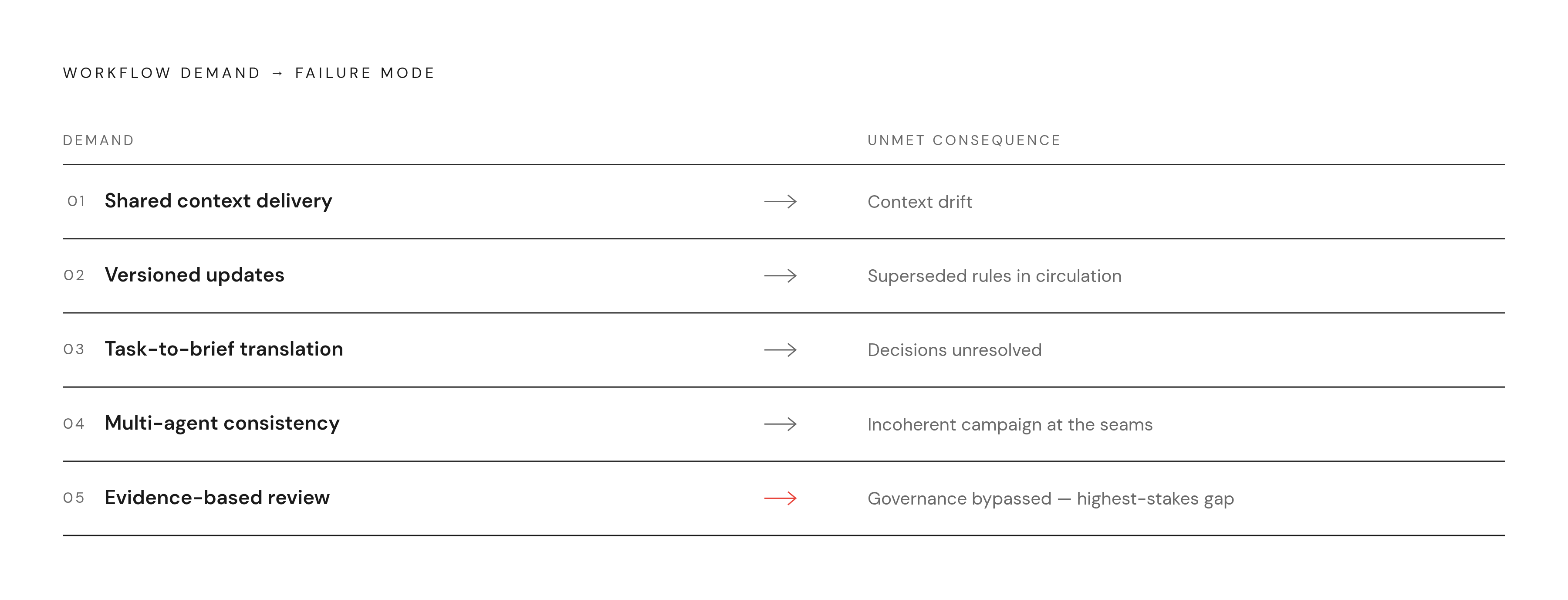
Without shared delivery, independently maintained instructions create context drift. Without versioned updates, superseded rules remain in circulation after the authoritative identity changes.
Without task-to-brief translation, generic voice rules leave agents to make decisions the brand system has not resolved. The resulting work can be grammatical, factual, and recognizably wrong for the brand. This failure is difficult to catch before publication. Without multi-agent consistency, the defect instead appears at the seams, where individually acceptable emails, advertisements, and landing pages form an incoherent campaign.
Without evidence-based review, production reaches an evaluation gap. Manual approval either consumes the speed gained from automation or is bypassed under pressure, leaving governance confined to paper. These gaps require different controls. Vishnyakova’s governing distinction explains why they must be addressed together. Context engineering controls what the agent sees, intent engineering controls what it pursues, and specification engineering defines what the organization demands at scale. Managing only one leaves the others unresolved.
A principled selection framework for matching tool architecture to workflow structure
The selection process should begin with the workflow. A team should map how many agents produce brand-touching work simultaneously, how many brands or clients it manages, and how frequently identity changes. It should also identify what triggers those changes. Compliance exposure, client relationships, and reputational damage establish the consequences of a consistency failure and therefore the rigor required of the surrounding controls.
The next step is to evaluate the five demands in order. First comes live, queryable context delivery rather than static export, followed by automatic propagation and version history. Translation then establishes whether agents receive task-scoped briefs. Consistency assessment examines parallel-agent compatibility and client isolation, while review assessment examines per-criterion evidence and configurable verifier thresholds. A tool that performs only some of these functions may serve single-agent, single-task work well without supplying the infrastructure required for parallel campaigns.
For workflows spanning agents, images, pages, and decks, the corresponding architecture connects agents over MCP and products through a REST API. It keeps versioned context in one place, translates identity into briefs, coordinates parallel work, and reviews finished assets with evidence. Some of a brand’s most distinctive qualities resist explicit articulation, and vague rules can produce drift regardless of the surrounding infrastructure. The team’s responsibility is to encode those qualities precisely enough for an agent to act on them. The software’s responsibility is to make that structured knowledge available and govern its use throughout production.