Wiring a Shared Brand Context Feed Into Every Agent Your Creative Team Has Already Shipped
MCP lets one governed brand source reach agents you already run.
Giving your own agents accurate brand context requires a shared, governed source of brand knowledge. MCP provides the connection layer between that source and agents already running, so each receives the rules and examples relevant to its task without a rebuild. Brand identity stays consistent when it is versioned infrastructure that agents read automatically, so people no longer have to paste guidance into each assignment.
Why agents already running in your stack keep producing off-brand output
An agent writing customer emails and another producing social posts can each perform well while creating contradictory customer experiences. Each may hold a different copy of the voice guidelines, or neither may have access to them. The failure sits between otherwise capable agents. Without shared context, sound decisions made in isolation do not necessarily add up to a coherent brand.
Voice drift makes this separation visible. A change to one agent’s prompt can alter its tone while the other agents continue using older instructions, producing mismatches between content types. Informal review can catch individual mistakes, but it does not repair the source of the disagreement. As more content goes out across channels, ad hoc prompting leaves more choices up to whichever bit of guidance happens to reach an agent. If the brand exists chiefly in a few employees’ heads or an unreadable PDF, the agent is working with incomplete information.
How do you give every agent the same brand understanding?
Shared brand context works like the configuration that software shares. Every agent reads from a governed source rather than maintaining its own independent account of the brand. The source needs owners for its context items and audit logs showing what each agent knew and when. An infrastructure agent needs context on security, deployment, and ownership, while a customer-copy agent needs guidance on voice and compliance.
The translation work begins with a Voice Profile. Tone, vocabulary, sentence structure, and prohibitions must become observable rules. “Confident and human” is not yet an executable decision. The profile needs to express what to do and what never to do, with examples of both. A Body of Work supplies the second component through annotated real examples that show how those decisions shape finished work.
Design Tokens provide the third component, encoding visual and structural rules in a structured file. The W3C Design Tokens Community Group specifies JSON for its design token format, though that specification is not a W3C Standard. Each extracted value is named by function in one file, because manually copying the same values into a second file creates another place for them to diverge. Tokens can also hold parameters for the brand voice along with visual rules. Copy and visual agents can therefore draw from the same source.
The operational principle is to treat that file like code. A version-controlled repository gives brand changes a recorded history, while agents reading the updated file adopt the new standards without separate prompt edits. This is more than digitizing a guideline document. The craft lies in re-authoring brand knowledge as decisions a machine can execute.
How MCP works as the connection layer between a brand context feed and agents already running
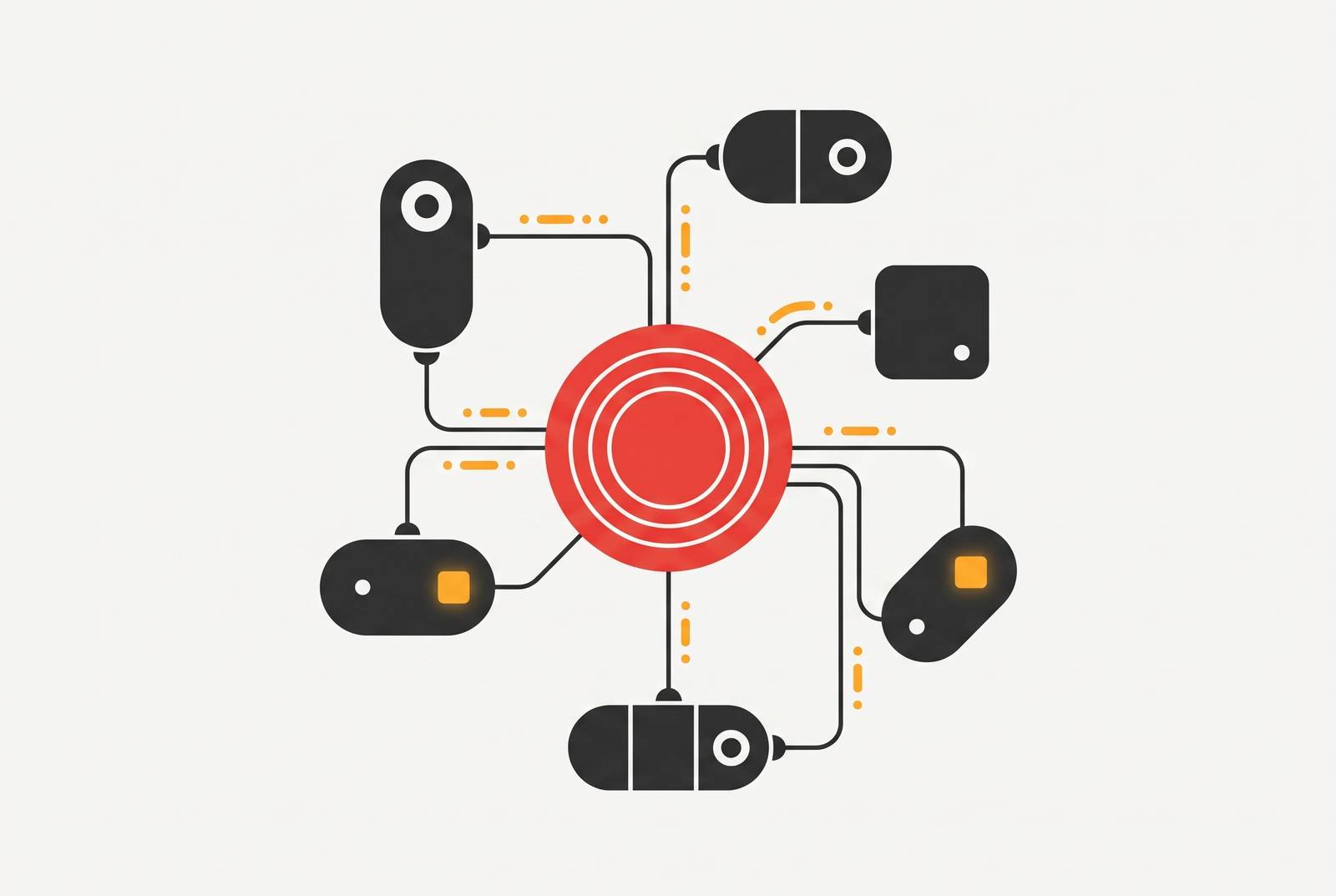
Anthropic’s Model Context Protocol announcement describes how developers make data available through MCP servers and how AI applications connect as MCP clients. The protocol replaces fragmented, bespoke connections with a shared interface. For brand context, the feed runs as a server and the agent connects through a client. The connection becomes reusable across compliant applications. An already-shipped agent can gain access through that interface without rebuilding its underlying workflow.
Resources provide read-only structured data such as product information, pricing, documentation, and voice guidelines. Tools let an agent check a brand rule, retrieve a logo variant, or validate a color token. Prompts supply templated instructions for handling brand-sensitive tasks.
MCP is the wire. It does not replace the work of authoring rules, annotating examples, or deciding which context belongs with which task. Its contribution is to remove the need for a separate hand-maintained connection between every agent and every source. Capability descriptions also need an editor’s care because their words shape how agents choose tools and explain what they do to users. A description is therefore both an interface label and a brand voice decision.
The context-cost ceiling and scoped routing: why a firehose approach breaks the architecture
Agents that share a connection still need limits on which assets and tools they can reach. Connected tools describe their schemas to the model, so a large tool collection can consume substantial context before the user sends a first message. That adds cost and noise before useful work begins. The architecture can therefore undermine itself even when its information is accurate. More available context is not automatically better task context.
Scoped routing addresses that constraint by matching the context slice to the assignment. A copy agent gets guidance on voice and compliance, while an image-generation agent gets design tokens and visual rules. A campaign planning agent gets the full brief template. These are different views of one governed source. Unlike independent copies of guidance, scoped views preserve common ownership without requiring every specialist to process the entire brand system.
Coordination between specialists is a separate concern from access to their data. MCP defines how an agent interacts with tools and information, while the complementary A2A, or agent-to-agent, protocol defines how agents coordinate, delegate, and share results. Both can operate in the same system. A coordinator can delegate over A2A while each specialist queries its relevant brand context over MCP.
What the retrofit looks like in practice: three patterns from teams that have done it
Alan, the French health insurer, uses Dust to give everyone in the company access to a Brand Voice Guardian agent. The agent reviews content for consistency with Alan’s distinctive tone, allowing departments to produce on-brand work without sending every piece to marketing for review. Alan’s broader suite of Dust agents also reduced customer story production from two days to a few hours.
Qonto, the European fintech, uses a different pattern on Dust. Its Tolki agent accesses a database of more than 200 localization instructions to adapt content for French, German, Italian, and Spanish markets. The shared instructions provide a common source that guides adaptation of emails, web pages, and social posts across four languages while preserving the brand voice.
XDS Agency organizes context around the client account rather than a company-wide editorial function or a localization task. Each account has its own AI workspace with information on its stakeholders, terminology, brand voice, and compliance rules. For a medical device client, the content generator includes regulator-required safety information rules in its instructions, so drafts arrive already structured for review. The team does not have to re-explain the account at the start of every session, and client-specific information remains separate from other accounts.
The agency pattern is especially relevant when one team serves several brands. Each workspace can preserve the vocabulary, obligations, and decision rules of its own account rather than relying on people to remember which instructions belong where. These cases demonstrate reusable review, localization, and account-context patterns. They ground the value of shared context without establishing that every deployment uses the MCP architecture described here.
Security and governance constraints that shape how a brand MCP server should be deployed
A centralized brand server is a privileged integration. Its value comes from giving agents access to trusted information and useful functions, but that access also widens the attack surface. The responsible deployment model is therefore controlled access with accountable use. A central server gives teams one place to apply those controls in the same way. It does not make the information or the connection inherently trustworthy.
Invariant Labs documented tool poisoning in 2025, in which a malicious server hides instructions inside a tool description that the model reads but the user does not see. The OWASP MCP Top 10 catalogues tool poisoning among its documented risks. Prompt injection creates a related problem when untrusted content smuggles commands into material an agent reads. Capability metadata therefore needs to be checked for security risks as well as edited with care.
An approved server allowlist, with access denied by default, limits which integrations agents can reach. A centralized MCP gateway provides a place to audit agent traffic, while OAuth identity and minimum permissions per tool constrain access. Scope is a containment boundary as well as a relevance filter. A server granted more access than its task requires can turn a small compromise into a much larger one. Requiring a person to approve destructive actions adds another check where the harm they could cause calls for it.
Content governance needs the same distinction between routine work and consequential actions. Requiring approval for every output creates bottlenecks that erode the benefit of deploying agents, while blanket permission ignores differences in risk. Tiered governance matches oversight to the task type. For teams that handle regulated data, gateway records and context histories also help show who was responsible for what.
Keeping the brand context feed current when brand identity changes
A shared feed remains useful only if it tracks changes to the brand. A refresh that still requires someone to edit every agent’s prompt has preserved the original fragmentation behind a new interface. The update must happen at the source. When guidelines change, the token file and voice profile change, connected agents receive the new version, and the record shows what each agent knew and when.
The same server can also expose a review capability that checks finished work against the current brand version before it ships. That check can produce evidence for each rule it evaluates. Review becomes part of the agent’s own workflow. It need not impose a manual gate on every task, and it gives tiered governance a concrete way to assess output against the guidance in force. The standard used to create work and the standard used to review it can therefore remain aligned.
For agencies, versioning must keep accounts separate in the way the context architecture sets out. A change to one brand’s voice profile or tokens must not propagate into another brand’s guidance, and each brand needs its own auditable history. Within that boundary, updates can reach all connected agents without redistributing instructions by hand. A recorded version that propagates to the right agents is the operational distinction between brand context as infrastructure and a configuration that begins to decay as soon as the brand changes.