Brand Context Layers for AI Agents
Consistent AI output requires structured, machine-readable brand context, not better prompts.

The brand layer for agents is a shared, machine-readable, versioned source of brand identity, style, narrative, situational rules, and governance. Brand Context Layers for AI Agents explains why consistent output depends on this infrastructure rather than creative capability or repeated manual prompting. Agents need the same up-to-date brand information when they generate and review work, across every connected product.
Why AI agents produce off-brand output even when they perform well on every other dimension
An AI agent produces one excellent asset, but the next task fails to reproduce what made it work. The reference that guided the first result is missing, the feedback has not persisted, and the preferred crop is no longer part of the instructions. The creative capability is still there. What has disappeared is the context that directed it toward the brand.
A consumer brand that ships a lot of ad creatives can get stretched logos, fuzzy palettes, random typography, and off-tone copy even when it uses capable models. Better prompts cannot resolve the underlying access problem. Prompt engineering makes the question better, while structured brand context gives the agent what it needs to answer it. When generation effectively resets with each task, consistency depends on reconstructing those conditions every time.
What brand context actually is, and why a PDF brand guide does not supply it
Brand context is structured, machine-readable brand information that an agent can parse and apply to a task. It makes existing brand knowledge operationally precise. Rather than merely reading a description of the brand, the agent can query the information, retrieve the relevant rule, and use it without a human translating the guidance into fresh instructions. The defining distinction is not whether the information exists, but whether it is available in a form that supports those actions.
A PDF or slide deck serves a different purpose. It communicates brand knowledge to people, who interpret examples, resolve ambiguity, and decide which rules apply. Someone still has to turn that document into instructions when it is passed to an agent. If each task depends on someone extracting a different selection of rules, consistency rests on those selections.
That distinction extends beyond visual production. A brand is also expressed through how it answers questions, solves problems, and maintains its presence across decentralized platforms. Its identity is behavioral and semantic as well as visual. Structured context therefore needs to guide language and choices for each situation as well as supply assets that give the brand a look people recognize.
The five layers that make up a complete brand context structure
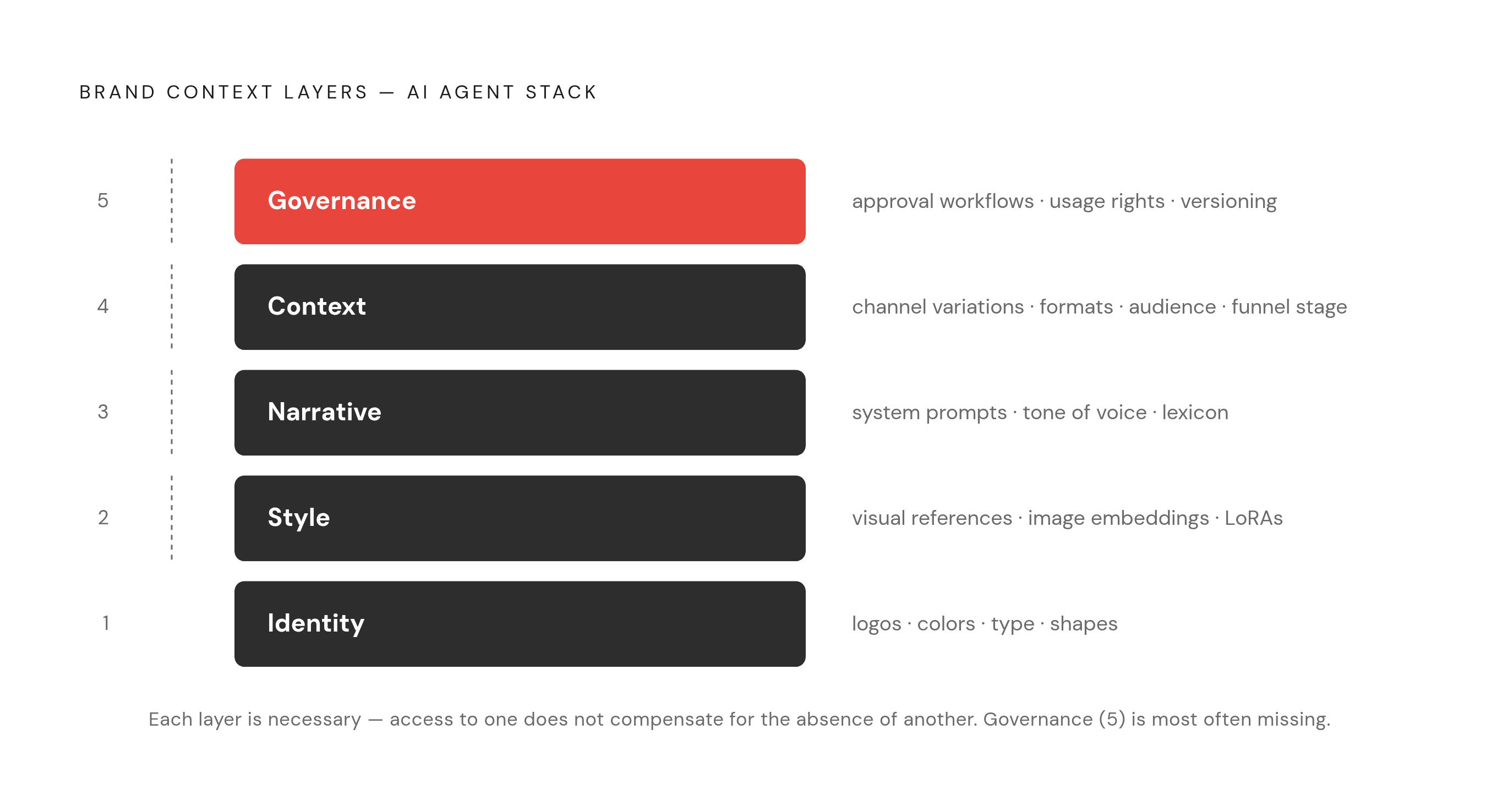
The identity layer establishes the fixed visual boundaries. It contains logos, colors, type, and shapes, giving an agent the visual DNA that defines what the brand looks like. These constraints establish the recognizable elements that should remain consistent while other parts of the work adapt to the task.
The style layer guides the look and feel within those limits. Visual references, image embeddings, and in-house LoRAs belong here because they communicate the learned feel of the brand. Style gives the agent a reference for the visual character that makes an asset belong to the brand, beyond using the correct components.
The narrative layer governs meaning and expression. System prompts, tone of voice, and lexicon define how the brand speaks and what it avoids saying. An agent that has identity guidance but lacks narrative guidance can make an asset that looks consistent but has copy that sounds wrong.
The context layer adapts that identity to the assignment. Channel-specific variations, formats, audience definitions, and funnel stages tell the agent where the work will appear and whom it needs to address. An agent can follow the right voice and still deliver content in the wrong format if it lacks the situational rules.
The governance layer keeps the other layers current and enforceable. Approval workflows, usage rights, and versioning belong here. Together, the five layers form a framework for identifying missing information. Their value depends on their interdependence, because access to one layer does not compensate for the absence of another.
How agents actually consume brand context — and where the consumption breaks down in multi-agent systems
Salesforce's 2026 agent trends report describes context engineering as the frontier beyond prompt engineering. The focus shifts to the information architecture around the agent, including which data sources it can see and what gets retrieved when. Access shapes the quality of the result. The agent harness also determines whose permissions the agent operates under and which systems it can reach, so model capability alone cannot establish reliability.
For brand work, consumption means retrieving the information that applies to the task. A channel-specific asset needs situational guidance as well as identity and style information. Its copy also needs narrative direction. The layers provide the anatomy of that information, while the agent depends on the surrounding system to receive it at the right point in production.
Multi-agent systems introduce a different failure mode. Each agent may have brand information, yet hold it in an isolated copy. Fragmentation then creates definition conflicts when two agents work from different versions of the same brand concept, while each added agent creates another provisioning obligation. The system resembles a group of freelancers working from separate briefs rather than a synchronized team working from a shared brief. Giving every agent the brand guide repeats that arrangement, because a point-in-time copy provides no single source to update when the brand changes.
How can multiple AI agents access the same brand guidelines through MCP?
Model Context Protocol gives agents a standard way to connect to and query one authoritative source of brand context. This replaces isolated copies with shared access. For brand production, the useful change is specific to the work being generated. Before producing an asset, an agent can consult the style guide, reference previous campaigns, and draw from the approved asset library rather than relying on general knowledge of what the brand might look or sound like.
Shared access also changes where brand information is maintained. The rules live in the authoritative source instead of in a separate set of instructions for each agent. The protocol connects agents to that source. It does not, by itself, make the source complete, current, or appropriately governed, so the five-layer structure remains necessary even after the connection is established.
Block built more than 60 internal MCP servers and put an internal AI agent running on MCP to work on tasks that include compliance workflows. Agents still need limits on what they can access, especially when they can reach tools and internal information. The Salesforce report identifies the need for governed gateway models because open access is not the same as safe access. For brand teams, that distinction connects technical access to the governance rules that determine what agents may use.
Why brand context must be versioned, not just stored
A shared source can still give agents guidance that is out of date. Rebrands, campaign pivots, new product lines, and updated tone guidelines change what qualifies as on-brand, even when the connected agents keep functioning normally. An agent can follow an old rule faithfully and produce work that is no longer appropriate for the brand.
The Salesforce report makes the broader observability problem explicit. An agent can return a plausible, well-formed response that is wrong for the situation without firing an alert or leaving an error in the logs. Versioning makes it possible to establish which context an agent was operating on when it produced a particular piece of work.
The operational principle parallels code versioning. When brand guidance changes, the change should become a versioned update that every connected agent picks up automatically. Governance makes that expectation enforceable through approval workflows, usage rights, and version history. Storage alone cannot do this work, because retaining information does not establish which guidance is approved for current use.
Superside trained a custom AI image model on Maven Clinic's brand and gave its team an on-brand Figma plugin, which made production cost much less than traditional shoots. The model encoded brand context as persistent state at the point of production. That case illustrates the value of structured context. Persistent state provides continuity, while version governance addresses the separate question of how that state remains aligned as the brand evolves.
Reviewing AI-generated output against brand context as a step in the workflow, not an afterthought
The same structured context that briefs an agent should also serve as the reference for reviewing its output before anything ships. Input access alone is insufficient. A system that provides brand rules during generation but never checks the result against them leaves the final decision disconnected from the standard that guided production.
In practice, QA agents can check outputs against brand guidelines, resolution requirements, platform specifications, and legal compliance rules before human review. These checks belong within the production workflow. These checks give reviewers evidence about the output so they can judge it with more than what they remember and how they read the rules. A rule checked against an asset is a firmer basis for approval than a general impression that the work seems consistent.
For marketing agents with publishing capability, the recommended workflow separates generation and staging from publication, with human approval required before release. Structured brand context gives people a clear reference when they approve the work. It does not eliminate judgment or imply that every creative decision can be reduced to a rule. Instead, it distinguishes checks that can be made against explicit requirements from decisions that still need a creative director.
Kapwing uses custom AI workflows trained on example reference images and a designer's prompts to extend that designer's expertise across more projects and surfaces without sacrificing brand consistency. The reference material establishes both creative direction and a quality standard. With routine checks built into the workflow, creative directors can spend more time on strategic decisions and less on catching the same technical errors.
What it means in practice to make a brand agent-ready across agents and products
An agent-ready brand has one canonical, structured, versioned source that every agent and product draws from. A prompt library cannot substitute for that source. Prompts can specify an assignment, but the identity, aesthetic, language, situational rules, and permissions governing the assignment need a shared home. The operational requirement is continuity across tools.
The implementation sequence begins by gathering the identity, style, narrative, context, and governance layers into machine-readable form. Agents then connect to that source over MCP or a REST API rather than receiving individually provisioned copies. Brand changes become updates to the source that connected agents pick up automatically. Generation and review use that same reference, so the workflow does not lose its standard between briefing and approval.
Agencies and multi-brand operators face the same requirement with an additional boundary. Each client brand is a separate context that must not bleed into another. Shared infrastructure therefore needs to treat brand management as a first-class workflow. The source can be canonical for each brand without making different brands interchangeable.
The resulting shift is from treating brand context as a creative input to treating it as infrastructure. Creative inputs change with each assignment, while infrastructure keeps the conditions for doing the work steady. The brand becomes agent-ready when its rules can be shared, updated, and applied across the full production workflow.