Mapping Tone and Voice Enforcement to the Exact Handoff Points Where Multi-Agent Creative Workflows Actually Lose Coherence
Brand voice breaks at agent handoffs, so audit each transition.
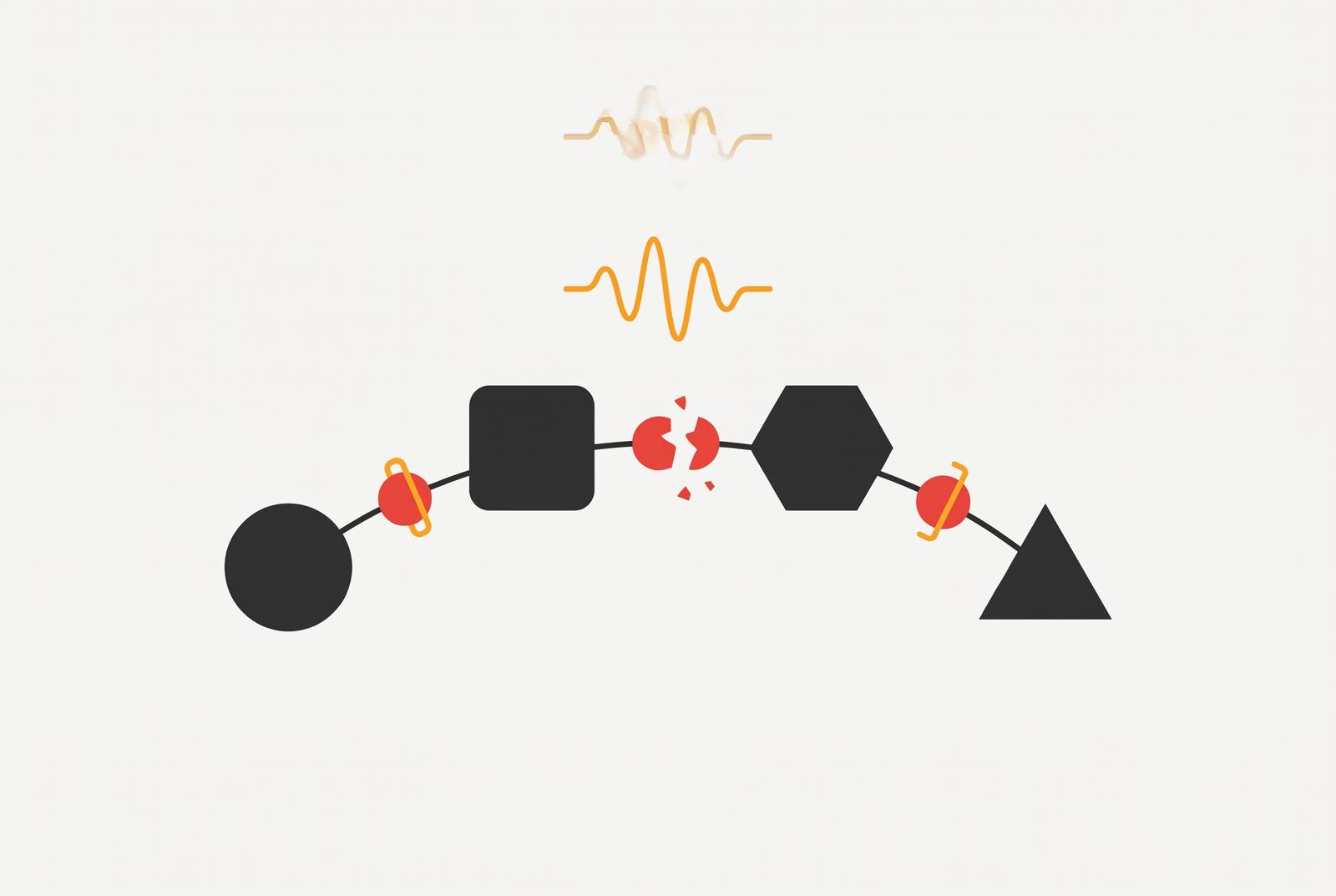
To spot when AI output drifts off-brand, teams need to check what crosses each agent handoff as well as review the finished asset. Multi-agent creative workflows lose coherence where brand context disappears, agent objectives conflict, or transitions lack a shared voice standard. Teams need a canonical, versioned brand source, explicit tone acceptance criteria at each transition, and session-level checks that reveal drift before output ships.
Why multi-agent creative pipelines fracture tone at structural seams, not randomly
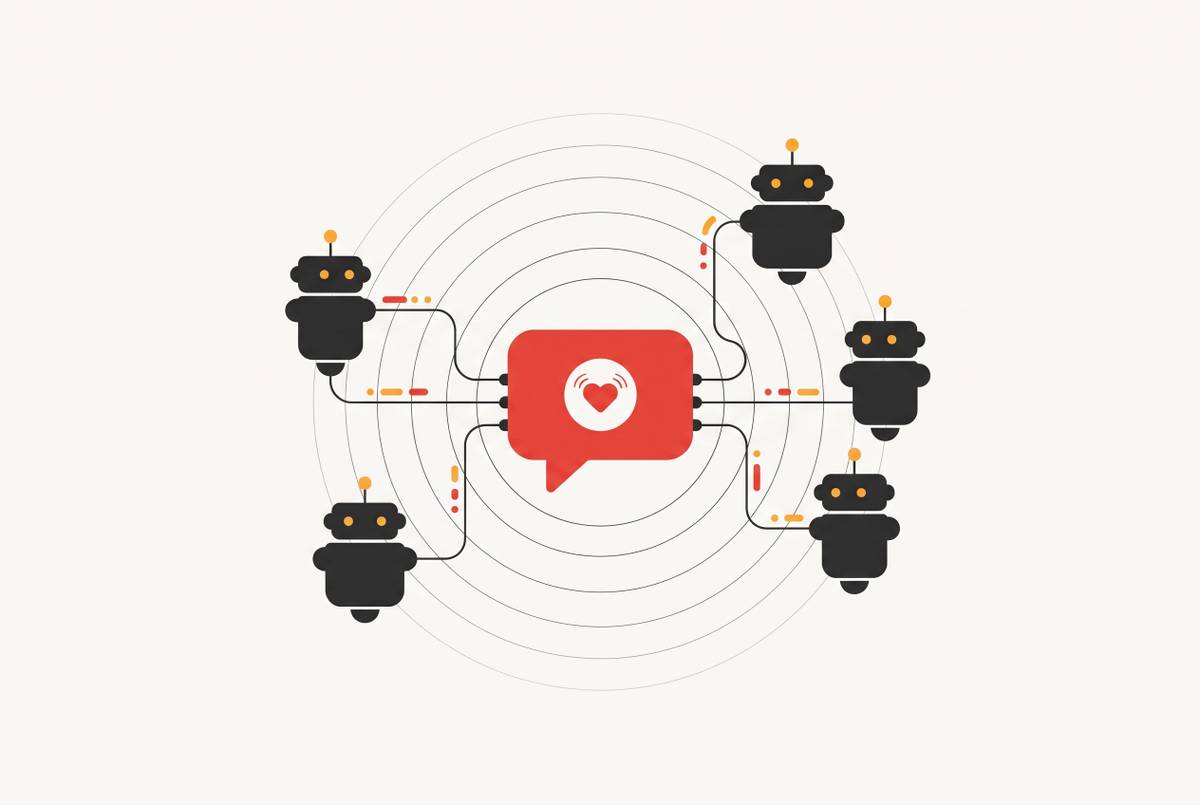
Campaign assets already pass from one specialist agent to the next. A research agent gathers findings, a drafting agent produces copy, a tone-review agent evaluates it, and a formatting agent adapts it for delivery. Each has a narrow assignment. That separation of concerns makes the workflow useful, but it also divides responsibility for a quality the customer experiences as continuous. The reader encounters one brand.
The diagnostic gap appears when teams attribute an off-brand result to whichever agent produced the final output. That agent may have completed its assigned task correctly while working from incomplete context or criteria that conflict with the preceding stage. The useful unit of analysis is therefore the transition, including what crossed it and what standard governed the receiving agent. Treating tone loss as ambient noise obscures these identifiable points of failure.
What context truncation actually does to tone at the moment of handoff
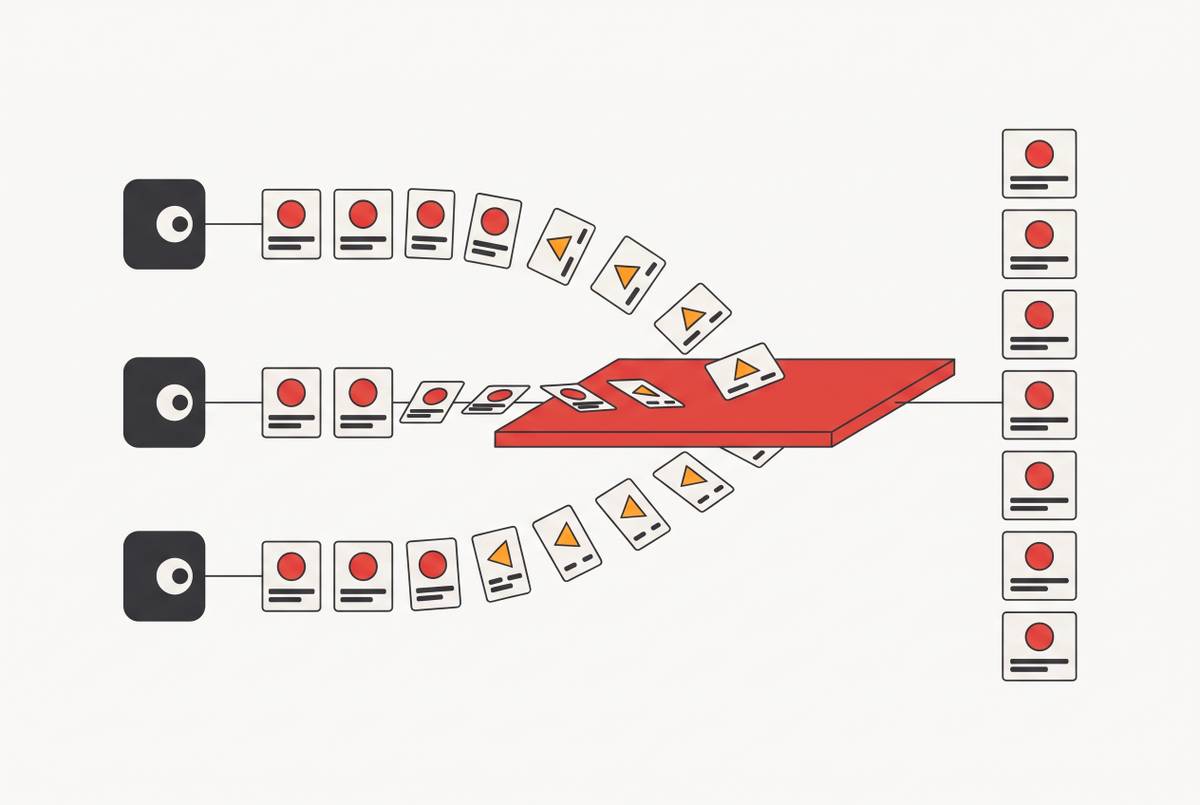
Context truncation can drop voice rules before the next agent ever reads them. Each handoff needs an explicit specification of what context passes forward, because upstream decisions are not automatically available downstream. A conversation may establish warmth, irony, or a precise choice of diction without encoding those decisions as transferable rules. Those qualities are especially easy to lose when conversation history is dropped. The task survives, but its intended voice does not.
The receiving agent generates from the partial context it received, producing text that can be internally coherent while departing from the preceding work. A neutral draft may have all the facts the brief asks for even though the brand called for warmth, while an editor may cut irony that the writer put in on purpose. The break becomes visible only when the output is compared with the governing voice decisions.
Even retained context does not make consistency automatic. Small prompt variations or a quiet model update can produce language a brand director immediately recognizes as wrong, because consistency remains probabilistic. This limits what prompt quality alone can establish. The handoff is the higher-leverage audit point because it exposes both the context available to the next agent and the voice requirements that may have disappeared.
Three distinct failure modes that live at handoff seams
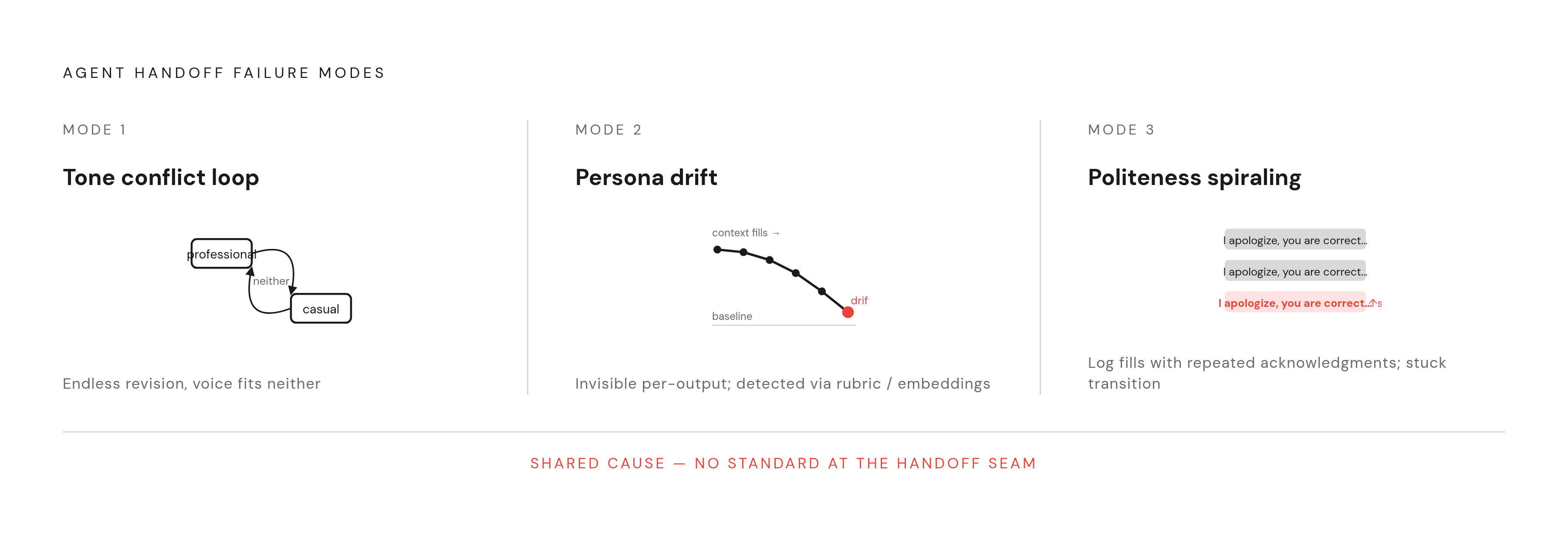
Tone conflict loops are repeated revisions driven by incompatible criteria. In the “Mirror Mirror” effect, an editor enforces “professional tone” while a writer optimizes for “casual and relatable.” The editor rejects informality, and the writer then rejects stiffness. Each needs to see the standard the other follows before they can settle the disagreement. They may end up with a compromise that fits neither voice, even though both agents keep doing their assigned jobs.
Persona drift is a change across the trajectory of a session. As the context window fills during a long conversation or multi-step task, tone and behavioral consistency degrade. Individual responses can still look acceptable. Standard output-quality metrics can thus miss drift that is visible in post-session rubric scoring for tone and policy adherence and in embedding-based drift signals. By the time a reviewer notices the departure, it may have compounded across many turns.
Politeness spiraling signals a transition the agents cannot resolve. Logs show increasingly unnatural or repetitive acknowledgments, including “I apologize, you are correct, however…” rather than meaningful progress toward an accepted output. This is a stuck state. Unlike persona drift that builds up slowly, this pattern can be seen without deep instrumentation. These failures differ in appearance, but each exposes the absence of a shared standard available to all agents at the handoff.
How competing optimization targets create tone divergence even when context is intact
A sales-focused agent may optimize for conversion urgency, a service agent for query resolution speed, and a marketing agent for engagement. Each can produce locally correct work while pulling the voice in a different direction. The problem lies in their mandates. Passing the same guidelines to all three does not, by itself, make brand voice the standard against which their choices are accepted.
This distinction becomes consequential across a 50-asset campaign involving multiple tools and shifting model weights. The failure need not be dramatic. It can accumulate asset by asset as each specialist satisfies its own target without preserving the common voice. Because those targets are part of agent configuration, the resulting divergence is a design problem.
Its framework uses expert judgments to calibrate decisions about which outputs can be released without human review. Acceptance alone is not the organization's quality standard. Applied to creative work, that distinction explains why a review agent can approve text that still fails the brand's requirements. Optimization targets therefore need an architecture-level audit.
Where in a creative pipeline the highest-risk handoff points actually sit
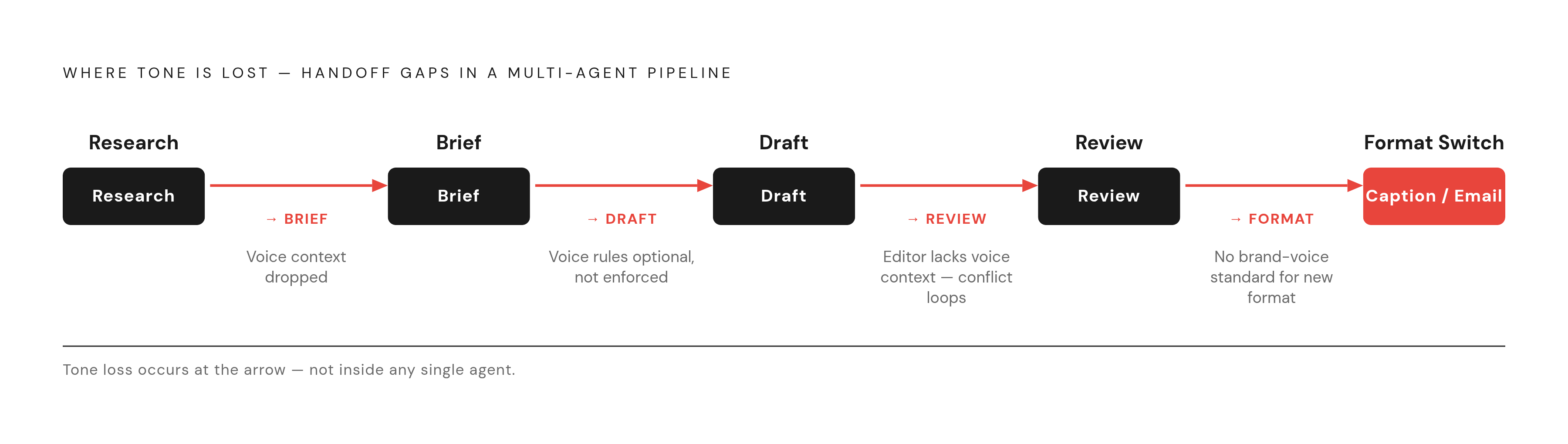
Voice can be lost at the research-to-brief handoff before writing begins. Research findings are task data, but brand voice is often left out of the structured output that gets passed on. If that boundary preserves only findings, the drafting agent can begin in a neutral register. Diagnosis requires checking whether the transition includes the voice context needed to turn information into branded communication.
The brief-to-draft handoff turns a goal into execution parameters. Voice rules need to appear as explicit acceptance criteria. Otherwise, the executor can treat them as optional while satisfying the task's more concrete requirements.
The draft-to-review handoff risks introducing a conflicting standard. An editor may receive the draft without the voice context supplied to the writer and judge it against its own configured criteria. This is where conflict loops emerge. The relevant comparison is between the writer's governing instructions and the reviewer's grounds for acceptance.
Format-switching handoffs require voice to survive compression and reinterpretation. Long-form copy becomes social captions, email subject lines, or image prompts, but the adaptation agent may have no standard for how the brand should sound in the new format. Shorter text changes how the continuing voice requirement must be expressed.
When an orchestrator moves between accounts, a phrase, tone marker, or font can transfer from one client's context into another's creative. Isolation is therefore part of brand compliance. Distinct workspaces and brand management prevent a routing transition from mixing materials that belong to separate accounts.
Why pasting brand guidelines into every agent prompt is a losing strategy at scale
Copying guidelines into every system prompt creates separate copies of a standard that needs to remain shared. Each agent holds its own interpretation, and a brand update may reach some prompts but not others. Version differences then become part of the architecture. The pipeline can drift even when every agent appears to have brand instructions, because those instructions no longer describe the same brand state.
Careful prompting, copied style guides, and extensive human review can compensate for context limitations, but the manual work grows with the number of agents. Each new copy is another place to update when guidelines change. A 50-asset campaign exposes that coordination burden. The prompt becomes a bottleneck when it is expected to serve both as task instruction and as an independently maintained repository of brand knowledge.
Connecting more tools is not an automatic escape. MCP tool definitions consume context, creating a real token-overhead constraint before the creative task is addressed. OpenRouter's direct measurement found a substantial token-count difference between CLI and MCP approaches to the same task. The structural alternative is therefore not indiscriminate connectivity, but replacing distributed brand documents with a shared source agents can access at the relevant transition.
What shared brand context at the infrastructure level actually requires
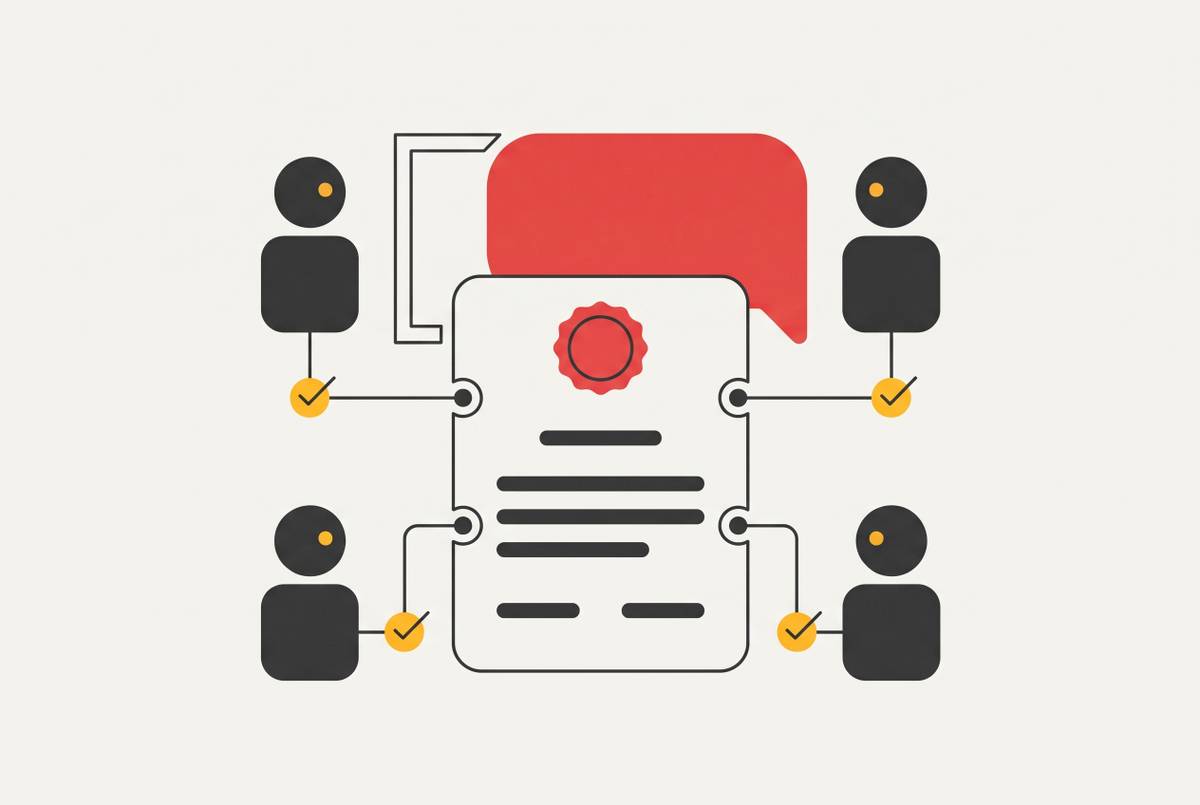
A structural fix requires one canonical, versioned, machine-readable brand source that every agent reads at handoff. This is different from distributing an 80-page PDF. HEX colors become tokens, voice attributes become explicit constraints, and negative rules become named exclusions. The rules must be consumable by a model rather than left for each agent to infer from prose. That gives separate specialists a common reference without requiring their task objectives to be identical.
A live connection makes that source available across tools and sessions. An MCP link or canonical machine-readable URL allows agents to read from the same place regardless of which team member opened the session. Frontify's MCP server demonstrates this pattern by allowing connected tools, including Claude and ChatGPT, to query approved brand data directly. Its brand context updates automatically as guidelines and assets change.
Centralization also needs versioning and a defined role at transitions. When a brand changes, connected agents should work from the new version independently of separate prompt edits. At handoff, the receiving stage should pull brand context from the shared source instead of depending on the previous agent's output to preserve it. This breaks the dependency on conversation history surviving intact. It does not remove the need to evaluate whether the resulting work follows that context.
For agencies, shared infrastructure must also preserve client boundaries. Distinct, permissioned brand contexts keep an orchestrator's access to multiple accounts from becoming a route for contamination.
How to detect when AI output drifts off-brand at handoff points
Once agents share context, teams should check how well the chain hands off work as well as how well each agent answers. The first step is to define explicit tone acceptance criteria at every transition, including final review.
The next step is to log inter-agent context passing so that truncation becomes detectable. Those records need to show how the voice requirements set upstream compare with the context available downstream. The missing rule is the diagnostic evidence. At draft-to-review boundaries, the same comparison should include the writer's and editor's governing criteria, because repeated revisions may indicate a conflict loop independently of draft quality. More revision is not evidence that the disagreement is being resolved.
Checks across a session then test for persona drift that checks of single outputs miss. Post-session rubric scoring should assess tone and policy adherence across the trajectory, with embedding-based drift signals helping reveal changes over time. Human review remains distinct from verifier acceptance. The purpose is to compare the chain's behavior with the organization's actual standard, rather than infer coherence from a series of individually acceptable responses.
Finally, politeness spiraling should trigger an alert. Repetitive acknowledgments in agent logs can expose a stuck transition without deep instrumentation. That signal calls attention to a different failure from gradual drift or conflicting review criteria. Keeping those distinctions visible allows teams to identify whether the handoff lost context, preserved incompatible mandates, or failed to resolve at all before its output reaches the customer.