Shared Brand Context vs Per-Prompt Instructions in Creative Workflows
Persistent brand context in shared systems beats repeating guidelines in every prompt.
This article looks at how shared brand context and per-prompt instructions work in creative workflows. Its conclusion is architectural. Repeating guidelines in prompts is a workaround, while consistent production requires persistent, versioned context that tools can retrieve. Rainbrand provides one implementation of that approach, but the essential choice is where brand knowledge lives.
Why AI output drifts off-brand even when everyone is using the same tools
Two B2B companies use the same model to write about the same topic, and their drafts are nearly interchangeable. Few readers would notice swapped logos. Contentoo uses this scenario to illustrate a context problem. Language models predict the most probable next word, so unguided output tends toward the average of what the model has seen. The result can be grammatical and accurate without belonging to any particular brand.
Contentoo's State of Content Teams 2026 found that the vast majority of content teams use AI regularly, and nearly half reach for AI first when output falls short. Yet another generation from the same defaults does not supply the missing distinction. A tone descriptor can change the register while leaving the model to fill in the rest. As people revise that output across different tools, small, individually reasonable changes accumulate into brand drift.
The structural difference between a prompt and a system
The underlying decision is where brand context lives. In a per-prompt workflow, a person pastes voice guidelines, positioning notes, or style rules into a session. Those instructions may improve that draft, but the next session starts the explanation again. Consistency therefore depends on someone remembering which rules matter and including the right version. The prompt carries the knowledge only for the work immediately in front of it.
The system prompt holds persistent behavior, while the user prompt says what the task at hand is. But even a well-structured system prompt stays with one tool, session, or user unless the architecture around it lets others share it. It cannot, by itself, govern what another person supplies to another agent. The structural gap is therefore not between a short prompt and a thorough one, but between local instructions and a common reference.
What per-prompt brand instruction actually fails to govern
A brief may live in a document, a visual in a design app, a draft in an AI tool, and scheduling in another workflow. Instructions supplied at one stage do not automatically govern the others. As prompts are copied and adjusted, each participant can introduce a different interpretation of the same brand. Faster generation spreads those different readings of the brand more quickly without bringing them into line.
A second failure lies in translating advice into rules an agent can apply. “sound friendly and professional” leaves more room for interpretation than “if channel = Instagram, allow lighter conversational phrasing; avoid slang in regulated or executive messaging”. A static PDF cannot close that gap merely by existing on a shared drive. Its guidance must take the form of structured, channel-aware constraints that workflows can use. Visual generation runs into the same limit when every image prompt has to spell out a style that persistent brand parameters could hold instead.
These are failures of scope. A prompt can guide the output it controls, but it cannot govern unseen sessions or preserve standards across disconnected tools. The operational burden consequently remains with people who must translate and check the work at each transition.
What shared brand context looks like as infrastructure
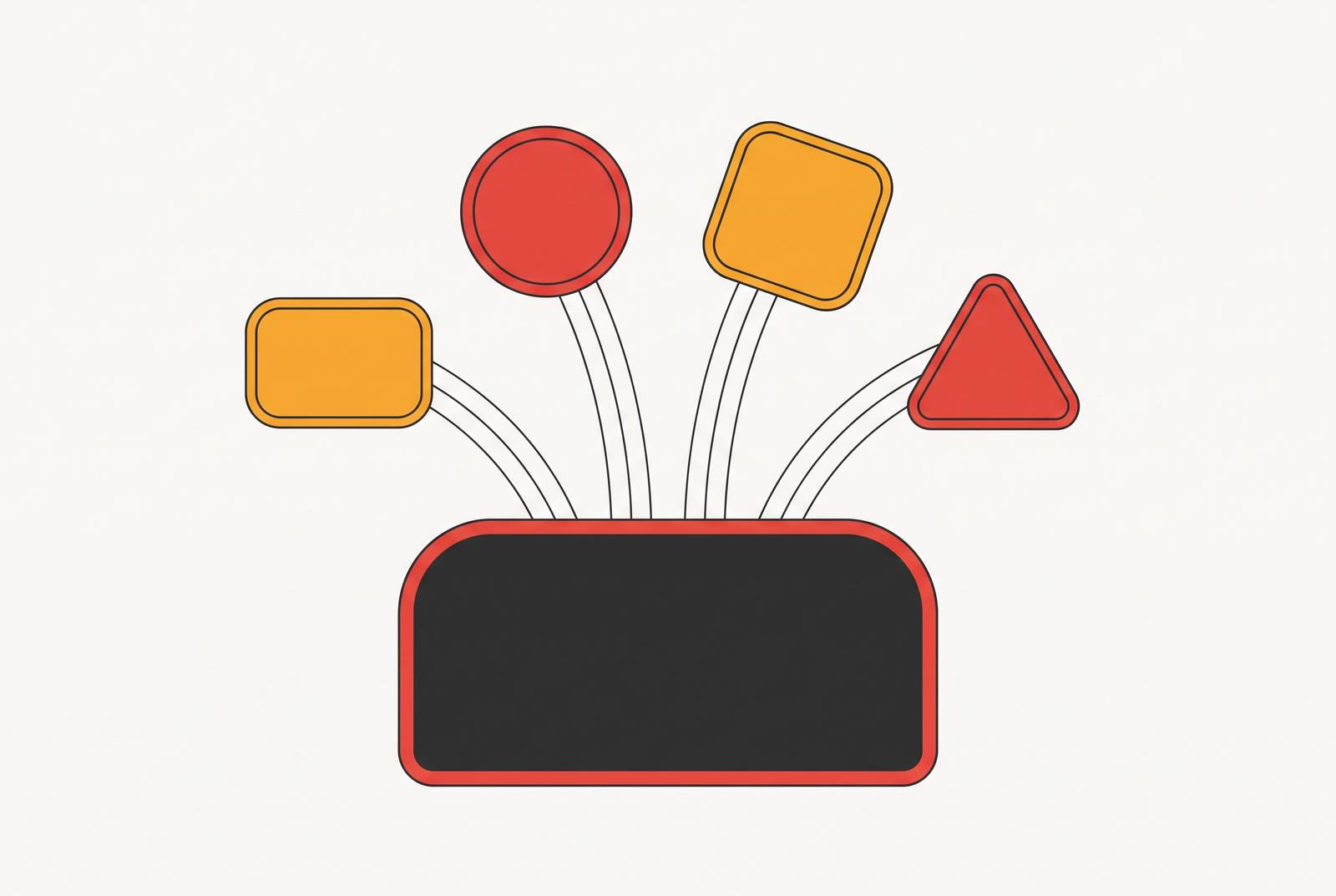
Shared brand context puts brand knowledge into a structured form that agents and workflows can retrieve. Voice, positioning, color systems, and typography become machine-actionable data through formats including JSON schemas, design tokens, and logical conditional rules. The purpose is to make explicit constraints available without asking each person to reconstruct them. That separates the brand's persistent rules from the instructions for a particular deliverable.
Design tokens illustrate the principle. When a brand color changes, its token updates once and propagates across the surfaces that use it. Applied to voice and positioning, the same logic creates a canonical reference. In implementations such as Rainbrand, this reference can cover aesthetics, voice, visual parameters, and asset libraries for connected agents. A copywriting agent, image generator, or scheduling workflow then retrieves context.
Retrievability and versioning make that reference infrastructure. Non-marketing teams can produce work from centralized standards without marketing having to explain those standards at every use. But positioning changes, visual systems change, and campaigns call for different tones. The shared layer must pass those changes on to connected tools. Context infrastructure that cannot be updated centrally will drift like copied prompts, only more slowly.
How MCP gives agents a standard interface to retrieve brand context
Anthropic open-sourced the Model Context Protocol on November 25, 2024, so data sources and AI-powered tools could connect securely in both directions. MCP gives an agent an interface to query brand context before it creates work. That can mean consulting a style guide, referencing previous campaigns, or retrieving approved assets. The protocol connects the agent to the source, but the source's guidance may still be unhelpful or outdated.
By 2026, the ecosystem covers Claude, ChatGPT, Cursor, Visual Studio Code, and thousands of MCP servers. OpenAI, Google, Microsoft, and Salesforce all shipped support. Adobe Marketo Engage launched its MCP server in beta in April 2026, and Amazon Ads launched its MCP server in open beta on February 2, 2026. These developments make retrieval part of the marketing architecture.
The benefit is a standard interface instead of a growing set of bespoke connections between agents and data sources. But independent benchmarks show that MCP adds token overhead and can be less reliable than direct CLI approaches for complex tasks. This is a tradeoff between coordination capability and per-task efficiency. MCP enables shared context, but it does not make context management or task evaluation unnecessary.
How Rainbrand and other tools implement shared brand context in practice
Rainbrand implements the shared-context approach by ingesting brand assets from files, websites, and design systems. It converts those assets into structured, versioned Brand Skills that connected agents can access through API or MCP. This addresses the central requirement of making brand knowledge retrievable outside individual prompts. For teams whose main need is a common brand reference across connected tools, that is a direct fit.
Rainbrand's Brand Skill is another way for teams to do this in MCP-compatible environments. Assets the team already has become a versioned context layer that connected agents can retrieve and use without having the brand explained each time. The relevant comparison is therefore about delivery and scope. Central storage alone is different from exposing brand knowledge in a form agents can retrieve during their work.
An agent can receive an interview recording, retrieve past customer stories as tone and template references, produce a structured draft, check it against voice requirements, and route it to human review. This approach fits teams that need shared context to support multi-step execution.
Custom-trained visual models address a narrower but important requirement. Training on a curated set of brand assets gives the model a persistent visual language instead of requiring a style description in every prompt. Approaches including LoRA and DreamBooth fit high-volume visual production, while LoRA training also extends to video. These approaches preserve visual identity at the model level rather than serving as a general reference for brand voice and positioning.
Who carries the highest risk from per-prompt workflows and who gains most from switching
Exposure rises as more people, tools, and brands enter the workflow. Teams spread across locations must otherwise rely on each person's reading of voice, so quality depends on who set up the session. Agencies managing multiple brands face an additional requirement for isolation. One brand's palette, typography, and tone must not contaminate another's context. The governing principle is one brand = one source of truth.
Founders and solo operators face fewer handoffs, but repeated explanation still consumes effort. Persistent context lets their tools retrieve who they are writing for. More is at stake when agents build complete deliverables. Wang et al.'s 2026 survey on agentic artifact creation links a construction policy, an operational representation, and runtime verification. Brand context belongs in that operational representation because verification needs a standard against which to assess the work.
This also changes the value of brand assets. A PDF that remains only on a shared drive does not contribute to agentic discoverability. Structured assets deployed across retrievable surfaces can serve more workflows as agents multiply. The payoff therefore grows with the number of systems that need the same brand knowledge.
The objection: shared context has its own failure modes
Centralization does not remove risk. If shared context is wrong, out of date, or too broad, every output that draws on it can have the same flaw. Scattered prompts fail unevenly, while a faulty common reference can spread an error across the workflow at once. Versioning makes change manageable, but it does not make the underlying judgment correct. A common source needs someone to take charge of it because it reaches more of the work.
There is also a practical limit to how much guidance belongs in shared context. Loading everything into a system prompt creates prompt bloat, dilutes attention, and encourages examples intended for one task to influence unrelated work. Keeping it up to date can be harder than keeping separate prompt files for each kind of task. Persistence should cover stable behavioral rules and brand parameters, with instructions that helped on a particular task kept with that task.
Contentoo's State of Content Teams 2026 distinguishes checks that can be automated from judgments that still need a person. Vocabulary, terminology, formatting, tone rules, and compliance can be checked against explicit requirements. Taste, ideas, and point of view cannot be delegated on the same basis. Shared context handles what is checkable, while a named human owner remains responsible for editorial judgment. That division limits both repetitive review and misplaced confidence in automation.
Making the switch: what moving from per-prompt to shared context actually requires
The migration starts by making rules machine-actionable. Replace broad guidance such as “sound friendly” with channel-aware constraints such as “if channel = LinkedIn, professional register; if channel = Instagram, conversational phrasing allowed”. This establishes what an agent can apply and check. It also exposes where a brand rule remains too ambiguous to automate. The immediate task is to distinguish persistent constraints from decisions that depend on the particular piece.
Next, audit where brand knowledge lives, including tone PDFs, messaging documents, brief templates, individual tool settings, and senior people's heads. Bring those fragments into one retrievable source for each brand. For teams looking at a dedicated context layer, Rainbrand offers the asset-to-Brand-Skills route described above. Teams scaling visual production can instead use persistent visual parameters through fine-tuned models or LoRA for that part of the workflow. The implementation follows the requirement rather than substituting a tool purchase for the migration.
Finally, treat changes to positioning, visuals, and voice as versioned updates that propagate to connected tools. Assign a named owner to taste, point of view, and editorial exceptions. If an update still requires manual redistribution, the workflow retains the weakness of documentation. Persistent, versioned context can improve as the brand evolves because each revision becomes part of the shared foundation. Per-prompt instruction resets that foundation every session, and that asymmetry is the argument for infrastructure over patches.