Why Brand Evolution Breaks Internally Built Agents and How a Persistent Context Layer Stops the Drift
A shared, versioned brand source keeps every agent current.

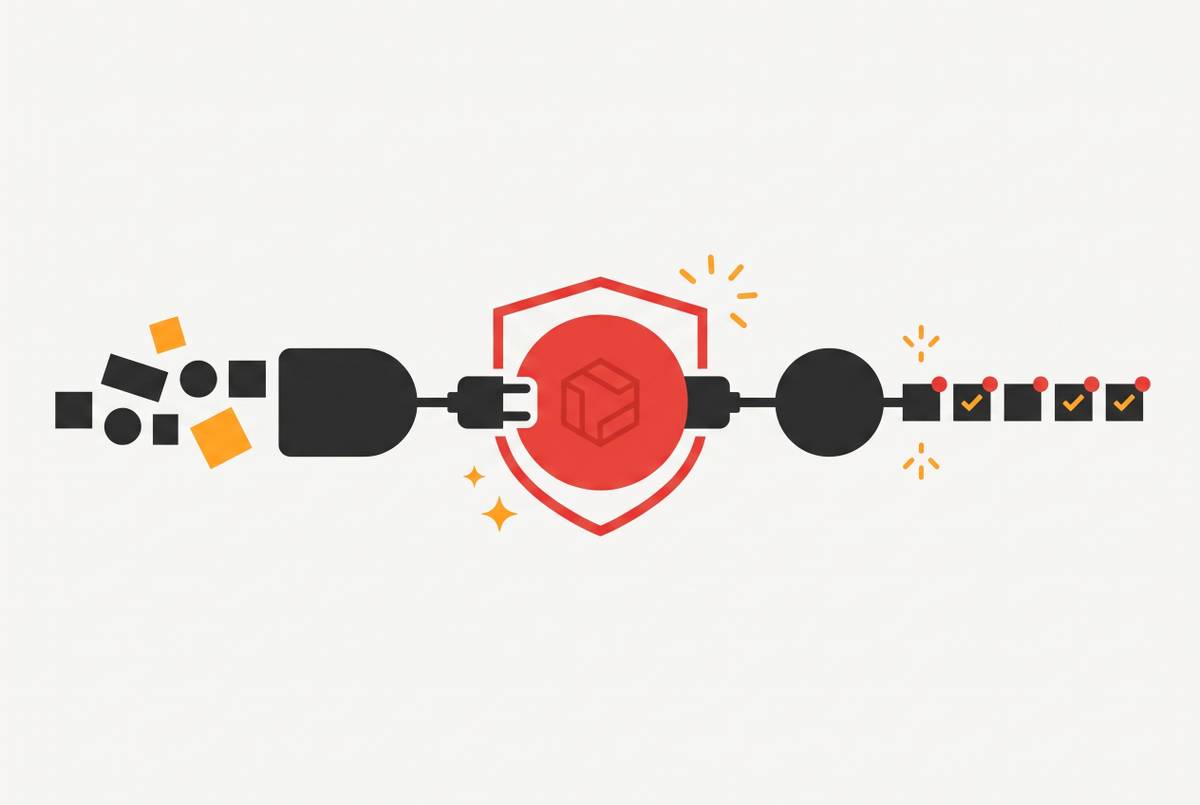
Giving internally built agents accurate brand context requires a persistent, versioned source of brand identity that every connected agent queries before generation. Static prompts break alignment when the brand evolves because they preserve yesterday’s rules. A shared context layer makes updates available automatically, while evidence-based review checks finished work before it goes out.
How brand updates silently break agents built on static brand context
A palette refresh, a voice update or a logo revision changes the brand without changing the agents built around it. Every agent with the previous identity embedded in a hardcoded prompt or static file continues generating from that identity. Nothing signals that its instructions have expired. The brand team may have approved the new direction centrally, but that decision does not reach the private copy held by each agent.
The resulting failure is not general AI inconsistency. An agent can follow its instructions precisely and still produce work that no longer represents the company. Brand identity encoded at build time becomes the agent’s ground truth, while the live brand moves on. The gap stays open until someone locates and rewrites the relevant prompt or file.
This distinction changes the diagnosis of off-brand output. A retired color or outdated positioning statement can appear even when a model reasons well and works reliably. It can show that the agent followed old instructions correctly. Reviewing the output alone exposes the symptom without explaining why the next generation will repeat it.
Why drift compounds quietly across a multi-agent system
With multiple agents, a single update creates multiple divergence points. Each agent holds a separate snapshot, and those snapshots can differ because different teams built or updated them at different times. A campaign can therefore assemble individually approved assets that do not match. Each component follows a recognizable brand definition, but the collection no longer expresses one identity.
A January 2026 arXiv preprint describes mechanisms that help explain how divergence can deepen across repeated interactions. Context Window Pollution happens when histories grow and earlier material that has no bearing on the task dilutes the context that matters. Reinforcement through Autoregression includes feedback in which previous outputs become future inputs, allowing an error to become precedent. In brand work, these mechanisms explain how a slightly looser tone can carry into later drafts.
The same preprint found detectable drift after a median of 73 interactions in its simulations. That illustrates why an eventual asset review may discover drift only after it has developed. Multi-agent handoffs add another opportunity for divergence. When each agent works from a different snapshot, vocabulary and conventions can separate from the intended identity even though each agent reasons consistently from its own instructions.
What the production record shows about how often this failure actually occurs
IAB reports that most surveyed advertising executives have experienced at least one AI incident, with off-brand material among the reported problems. Other incidents include hallucinations and biased or inappropriate content, so the finding does not establish that most respondents experienced brand drift specifically. A large share nevertheless had to pause or pull campaigns.
Adobe Experience League reports that a majority of brand professionals need seven or more people to approve a single on-brand asset. Yet most say content is often published without completing that approval cycle. The process is already being bypassed. Faster agent output increases the volume moving through a review system that cannot reliably finish its existing work.
IAB also reports that a small minority have no owner for AI governance, while others are unsure who owns it. People working at agencies say brand integrity clauses are standard in enterprise agreements, so differences in how a product is shown or drift in brand colors can lead to a failed audit as well as disagreement over how the work looks. These findings establish a broader production and governance problem. They also expose a mismatch between agent-speed generation and approval chains designed around individual assets. More output reaches the point of publication before the brand-level review is complete.
Why written brand guidelines and manual prompt updates cannot close the gap
Written guidelines describe the target but do not distribute changes. A person still has to translate each revision into every agent’s context, correctly and under deadline. That translation can leave agents with different definitions before they even start to generate work. Tool A receives a hex value, Tool B receives the phrase “warm coral,” and Tool C receives a JPEG containing Tool B’s interpretation. All three can trace their instructions to the same guide without sharing the same rule.
Pasting the guide into every prompt can work for one agent, one session and one asset type. At the moment of brand evolution, however, the pasted guide becomes the old guide. The prompt contains no mechanism for discovering which other agents still hold it.
Manual updates also require more than replacing text. Teams must locate each hardcoded prompt, understand what it encodes, rewrite it, test it and deploy it across different tools and owners. Every additional agent expands that maintenance burden. Better documentation can make the intended change clearer, but it cannot make disconnected copies receive that change. The unresolved gap is architectural, because a static-prompt system has no mechanism through which a central brand update propagates to its agents.
How a persistent, versioned context layer eliminates drift at the source
A persistent context layer gives agents a shared source to query before they generate work, in place of their private brand snapshots. The source holds the current rules, and connected agents retrieve those rules for their work. A brand change then changes what agents read without someone having to rewrite each agent’s instructions.
Persistence, versioning and propagation distinguish this architecture from a shared document. Persistence keeps brand context at hand from one session to the next without relying on a pasted reference. Versioning records an update as a new version while preserving the previous version for audit. Propagation follows from retrieval, because every connected agent reads from the updated source on its next task.
The code-versioning analogy is useful but limited. Brand rules behave like a shared dependency when agents resolve them from the current source. In a multi-agent pipeline, that shared layer also resolves definition conflicts at their origin and preserves state that downstream agents can query. Governance policies set there reach all the connected agents at once.
In practice, the source takes the form of a brand ontology, a structured, machine-readable representation of the identity. It covers visual identity, voice and tone, messaging, audiences, channel context, design systems and approved assets. Agents get the rules they need without having to work through an entire PDF. This removes stale-source drift under a clear condition, which is that every connected agent queries the current layer as its authority before generation.
How MCP makes accurate brand context available to every agent your team deploys
MCP makes the shared layer accessible through a common protocol. An MCP server can make voice rules, visual identity, positioning and brand prohibitions available as context that compatible agents query before they produce words or pixels. The protocol connects agents to the source. It does not replace the need for structured brand rules.
When the brand changes, the server serves the new version. Each connected agent querying it for its next task receives the current identity rather than the identity available when that agent was built. Teams can revise the shared identity without reconfiguring the brand separately in every compatible tool.
Stripe, Linear, Sentry and Vercel established examples in 2025 of making proprietary context queryable through MCP. Agents built on Claude, ChatGPT, Cursor, Codex or another MCP-compatible tool can draw from the same brand context layer. These are connection options, and their usefulness here depends on querying the same authoritative rules.
What brand identity needs to look like for agents to consume and enforce it reliably
A shared source only helps if its contents are actionable. “Sound friendly and professional” leaves an agent to interpret both adjectives, potentially in different ways across tasks. Enforceable voice rules instead specify sentence length limits, permitted contractions, banned phrases, proof standards for claims and audience-specific vocabulary.
Visual identity requires the same precision. People working in production say drift in color and type is especially easy to see across AI generations. Canonical hex values, typeface names and reference images provide firmer inputs than prose descriptions such as “warm coral.” The distinction is between a defined value and an interpretation. Keeping the value as structured data lets agents get the same definition from the same version.
The wider context needs comparable structure across logo treatment, photography direction, messaging pillars, banned claims, audience definitions and channel-specific variants. Each component must express a constraint. Together, these rules provide the context a seasoned employee would use to distinguish acceptable expression from a superficially similar alternative. Their usefulness comes from making those distinctions explicit.
That does not mean every task needs the entire identity. A persistent context layer creates a brief for each task with the logo, type, color, imagery and voice rules it needs. A campaign image, web page, launch deck and email draw on different subsets of the same source. Retrieval keeps those briefs focused without creating separate authorities. When the source changes, the next brief reflects the current version rather than preserving an independently maintained interpretation.
Reviewing AI output against the brand before it ships, with evidence for each check
Current context does not make finished work exempt from review. An output may follow the retrieved rules yet be wrong for its application, such as a tone that is on-voice but strategically off. A visual can also pass individual review while conflicting with the campaign assets around it. These are application and composition failures.
Systematic review compares finished work with the specific rules it should satisfy and records evidence for each check. That makes the result repeatable and auditable rather than dependent on whether an individual reviewer thinks it feels right. The review belongs before publication.
For agencies that work with multiple brands, this also means keeping those identities separate when they share workflows. Bynder’s agentic platform illustrates the review pattern through Logo and Brand Detection, including recognition of brand colors, detection of logo placement, flags for missing or incorrect branding, and distinction between multiple brands at asset-library scale. This capability addresses a different part of the architecture from context retrieval.
When the versioned source changes, connected agents get the current rules, briefs for each task guide what they generate, and finished work is checked against the brand with evidence recorded. Adding reviewers alone cannot provide that propagation path. When agents use the current versioned source as their authority, drift caused by obsolete brand context is an architectural failure made impossible by design.