Creative Variant Testing Frameworks for Paid Social
Systematic testing frameworks now determine creative success more than individual ad execution.
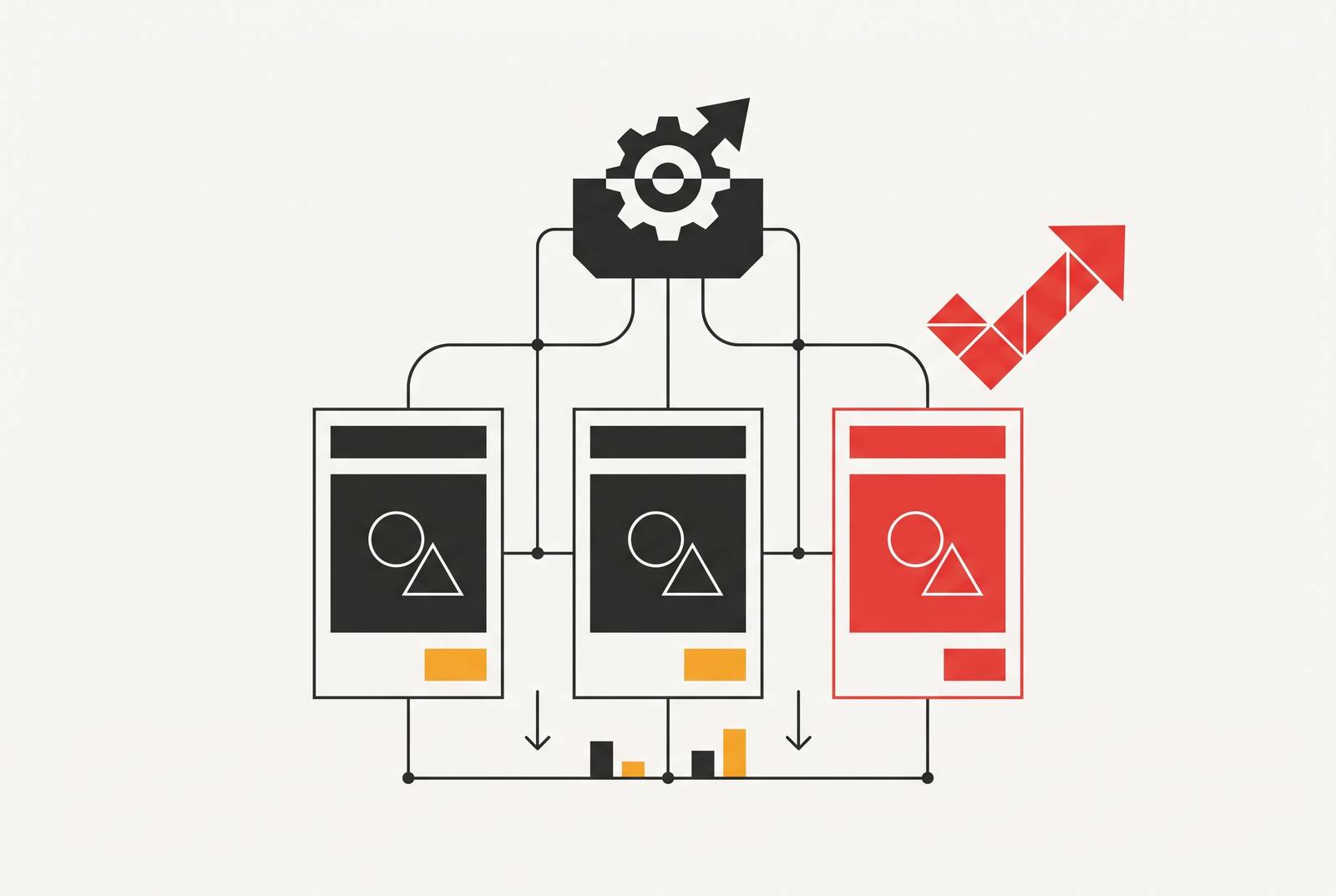
Creative variant testing in paid social is no longer a matter of taste. It has become the primary mechanism by which a media buyer either compounds learning about an audience or burns budget against a platform that is already making its own judgments about the creative. The argument that follows is that the framework itself, not any individual ad, is the strategic asset.
Why creative quality is now the dominant lever in paid social auctions
The platforms have quietly reordered the auction such that creative is no longer one input among many but the input that determines whether bidding begins at all. Meta's Andromeda retrieval engine narrows tens of millions of candidate ads to a few thousand before the auction runs, and it does this by reading the creative itself. What this means in practice is that the ad's message, format, and execution now function as the targeting input. The creative is the entry ticket, and no amount of audience sophistication can compensate for an ad the retrieval layer declines to surface.
Once Andromeda makes its first pick, GEM, the Generative Ads Recommendation Model, ranks what is left. GEM is trained at the scale of large language models, and it learns from long sequences of clicks, views, and interactions. Teams that keep the same post alive while iterating around it preserve an advantage that duplication throws away.
The competitive effect is already visible. If you run a single creative set across broad audiences, you lose delivery share to competitors who rotate multiple distinct concepts through Advantage+ and CBO structures. The margin for error on creative decisions has narrowed because the platform now rewards conceptual breadth at the retrieval layer. That is the operating environment in which the framework becomes the most important account structure decision a team controls.
What a creative testing framework actually is, and what it is not
A creative testing framework is not a process for deciding which ad looks best. It is a documented, repeatable system for generating hypotheses, running controlled experiments, and feeding results back into future production. The core loop is consistent across serious practitioners: form a written hypothesis, isolate the variable being tested, run the test under controlled conditions, measure the right metrics in the right order, and iterate based on what the data says. Each cycle compounds understanding of what a specific audience responds to, and that compounding is the point.
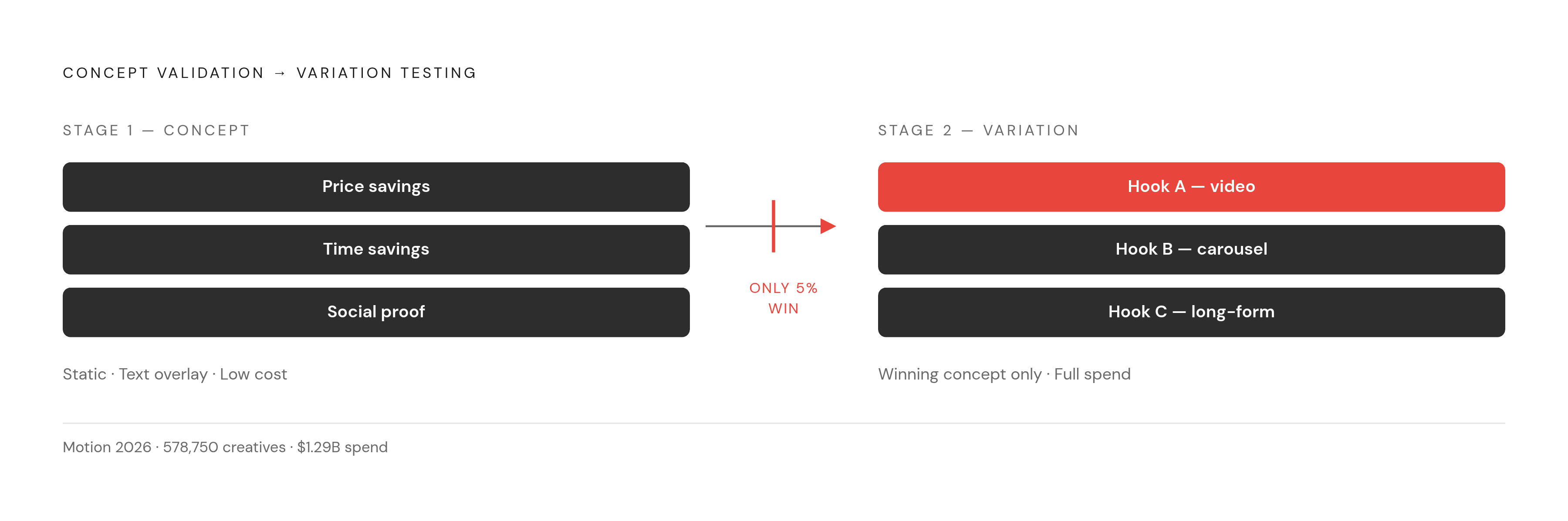
The distinction between concept testing and variation testing is foundational and must be internalized before any framework is chosen. Concept testing tests the message, angle, or positioning: price savings versus time savings versus social proof. It happens before production investment. Variation testing tests executions of a validated concept: three different video hooks for the winning time savings angle. It happens only after a concept has won. Running both at once conflates what one is actually learning, and no amount of post-hoc analysis can untangle the results.
Within each ad, independently testable modules exist in sequence. The hook controls thumb-stop rate. The body controls hold rate. Testing hooks first makes practical sense because engagement with later modules is conditional on the hook working. The most common failure modes all map to missing framework elements: testing too many variables at once, calling winners on insufficient data, ignoring upstream engagement metrics, and never documenting why a creative won. Without written hypotheses, controlled variables, defined thresholds, and a feedback loop, every test produces noise instead of signal. The absence of a system is what most programs fail on.
Why testing concepts before variations is not just good practice — it is the correct order of operations
Under the current retrieval architecture, testing variations of the same concept before validating the concept itself wastes budget on differences the platform treats as identical. A concept is a genuinely different idea: a different angle, persona, format, or emotional register. A variation is the same idea with a new headline or color. Under Andromeda, variations collapse into one retrieval candidate, which means the system is not seeing breadth where the advertiser believes it is providing it.
This has a direct implication for production economics. Static images or text overlays are the cheapest way to validate a messaging angle before committing to video production. Concept validation should happen at the lowest production cost, not after the full asset is built. The practical sequence is therefore: validate the message angle with cheap static tests first, and only once a concept wins does it justify the production spend for video, carousel, or more elaborate executions. Volume of similar assets does not expand reach. It fragments data across candidates the system treats as one.
The honest hit rate makes this order of operations non-negotiable. Motion's 2026 benchmark across 578,750 creatives and $1.29 billion in spend found that only about 5% of ads become winners. Any framework has to be designed around that number, which means maximizing distinct concepts tested, not variations per concept. Most ads that fail never had a real chance because they were not distinct ideas. They were the same concept in different clothes, and the retrieval layer had already collapsed them into a single candidate before the test could say anything meaningful.
The named frameworks practitioners use and what each one is actually designed for
No single framework is universally correct. Each of the dominant approaches is a different answer to the same constraint set: budget, conversion volume, and creative output capacity. Picking the wrong one for a given situation breaks the system before a test even runs. The 3-3-3 framework, popularized by Pilothouse, structures testing as three concepts, three executions of each, and three hooks per execution. It addresses the conceptual diversity requirement directly by forcing three genuinely different angles before any variation work begins, and it is designed for teams with sufficient creative throughput to populate the matrix.
The 3-Phase model takes a different approach. It gates creative through stages rather than organizing by matrix dimensions. Pre-Flight tests new concepts in a dedicated testing campaign. New vs. BAU has winners competing against the best-performing active ads. Scaling is where proven winners receive committed budget. A concept must earn its way into competition with proven performers before budget is committed. The 3-Phase model and the 3-3-3 matrix are not competitors; Pre-Flight, New vs. BAU, and Scaling can work alongside the matrix rather than replacing it.
The 60/30/10 portfolio model governs budget allocation rather than test structure. Sixty percent of spend goes to proven performers, thirty percent to promising challengers, and ten percent to experimental formats. It prevents ad fatigue while maintaining a pipeline of new creative in rotation, and it operates as a budget governance layer on top of whichever testing structure a team uses. Meta's in-campaign Creative Testing tool offers a different mechanism entirely: a true split test of two to seven ads inside an existing ad set, with spend split evenly and no viewer seeing more than one variant. The default duration is seven days, and Meta recommends giving the test no more than 20% of the ad set's budget. When a winner emerges, it should be graduated by Post ID rather than duplicated, so the engagement history GEM reads remains intact.
The constraint that governs all framework choices is Meta's own guidance targeting roughly 50 optimization events per ad set in a seven-day window. Testing structures that split budget into many small ad sets only work for accounts with the conversion volume to feed each one. Accounts below that threshold should consolidate before experimenting with elaborate test architectures. Variant count should be set from the conversion volume expected during the test window, not from the size of the production batch or the rate card. A team producing twenty assets where each receives only a handful of conversions cannot support a dependable decision, regardless of how elegant the test design looks on paper.
How to design and control a single test so it produces a usable result
The quality of a test's output is determined before the campaign launches, by the precision of the hypothesis, the discipline of variable isolation, and the definition of the decision threshold. A hypothesis without a because clause is a preference wearing a lab coat. One variable per test cell is the rule. Any difference in these variables contaminates the creative read.
The testing variable priority order by impact is hook first, then offer, then format, then value proposition, then call to action. A/B testing isolates one variable, requires the smallest sample, and produces the clearest causal read, making it the right tool for most creative tests. Lift testing measures incremental impact against a holdout group that sees no ads, and is the most reliable way to prove ROAS at scale, but requires the highest budget and traffic. Channel-specific timing rules matter: a Meta creative test can be completed in seven to fourteen days, while Amazon PDP experiments run longer and only on eligible listings. Applying one calendar to channels that run on different clocks is a structural failure, not a data problem.
Reading results correctly: the metric ladder and the decision threshold
Using CPA or ROAS as the primary creative test metric conflates creative performance with landing page, offer, and audience effects. Hold rate, fifteen-second video views divided by three-second views, answers whether the story held attention. Only after those upstream metrics qualify the creative does CPA or ROAS answer whether the funnel converted. Conversion data alone cannot tell which part of the creative failed. Design a sharper hypothesis and re-test rather than scaling a marginal result.
Qualitative analysis accompanies the quantitative read. A creative can win on CTR and still fail the brand. The algorithm fluctuations in early days make premature reads unreliable, and a test cut short produces neither a valid winner nor a usable insight. The discipline is to let the defined window elapse and then read the ladder in order, which is the only way a result becomes knowledge.
The feedback loop: how test results become durable creative knowledge
A creative testing framework only becomes a strategic asset when its outputs are systematically documented. After sustained use, this document becomes the single most valuable asset the paid media team owns. Failed tests are not wasted spend. High-spend ad sets need more frequent refresh than lower-spend sets, and building the refresh cadence into the framework prevents the failure loop in which a winner fatigues, CPA spikes, and the team returns to square one. Tagging creative assets with structured attributes such as theme, format, message, and creative element lets performance data roll up by attribute instead of per-ad. Each documented cycle informs the next hypothesis, and the framework's value grows precisely because it never starts from zero.
Why AI-generated creative volume makes the framework more necessary, not less
AI-assisted creative generation can produce testing volume at a pace no human team can match, but volume without a framework produces noise faster, not signal faster. AI-generated ads have shown higher CTR on Meta than human-created ads in recent analysis, largely because of this volume and combination breadth. If you optimize click-through while you ignore brand perception, you win the auction and lose the brand.
Three human decision gates survive full automation and must not be removed from any AI-assisted testing pipeline. These gates are not friction. They are the difference between an industrial testing system and an uncontrolled production line. Brand drift at AI production volume is a structural problem, not a prompting problem. The framework must therefore treat brand context as an input to the generation layer, not a review step after it.
Brand context as a system input: making creative guardrails machine-readable
Brand consistency at AI production volume requires brand identity to be encoded in a form that generation tools can query before they produce anything. Instead of "sound friendly and professional," the instruction becomes: use contractions, second person, sentences under 25 words, no jargon. Instead of "keep it on-brand visually," it becomes: primary #1A1A1A, accent #FF5A3C, never gradients, photography not illustration, 40px minimum logo clear space.
Three technical layers build a machine-readable brand identity. Schema markup in JSON-LD declares the brand's canonical name, logo, description, and social profiles, serving as the primary entity signal for brand identity in AI systems. A versioned content API returns structured, timestamped answers about pricing, features, or documentation, removing the guesswork AI agents encounter when working from outdated crawled text. Rather than each team member pasting brand guidelines into every prompt, a Brand Skill exposed via MCP becomes one canonical source of truth that any connected agent pulls from before generating a word or pixel.
Rainbrand structures brand identity as a versioned, retrievable Brand Skill, ingesting websites, social media, files, brand guides, briefs, and logos and transforming them into structured context that AI agents, products, and workflows can consume via API or MCP. The outcome is visible in Superside's work with Maven Clinic, where a custom AI image model and an on-brand Figma plugin cut production costs significantly compared to traditional shoots because the output was brand-correct at generation rather than corrected in review. Attributes can only roll up by theme, format, and message if those attributes are defined consistently, and consistency at scale requires a shared source of truth, not per-session prompt construction.
The framework as the compounding asset, not the individual winning ad
The teams that pull ahead in paid social are not the ones with the best individual ad. After restructuring, the team produced three to five winning creatives per month with predictable performance, and the predictability came from the system, not from better creative instincts. Six months of disciplined documentation produces an asset that tells a new team member more about the audience than any individual brief could. Applied as an ongoing governance layer, the 60/30/10 portfolio model keeps the system from ever stalling. Not any single winning ad, which will fatigue, but the system that finds the next one and the one after that.