Producing High-Volume UGC-Style Ad Creative With AI
AI tools let brands test ad creative at scale, but only systematic testing prevents generic results.
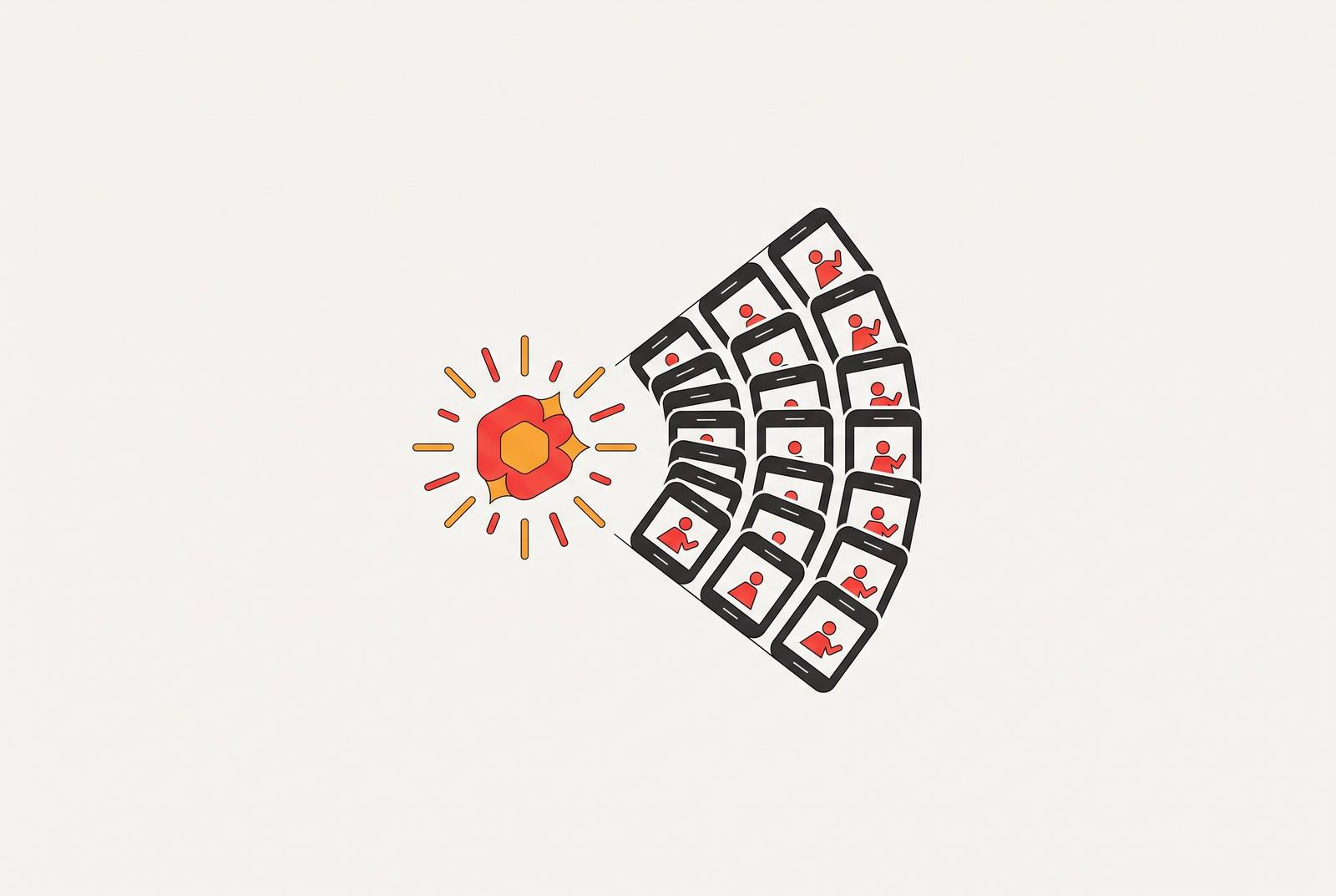
A winning ad on Meta or TikTok can lose its edge within weeks, sometimes within days. Teams that can't keep up with the pace the auction demands are simply handing the advantage to the competitors who can.
What AI UGC tools actually produce and how the economics change
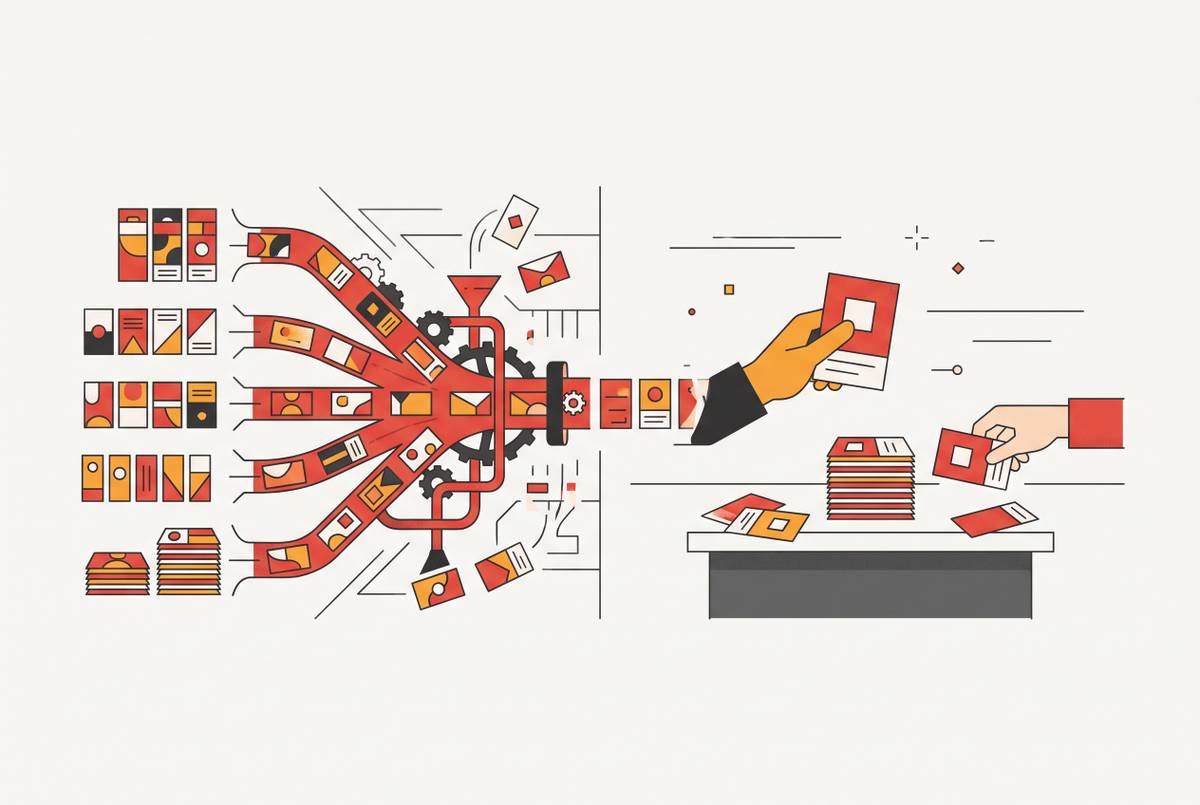
AI UGC tools cut the human creator out of the production loop. A brief goes in, and a complete video ad comes out, built from a synthetic avatar, a synthesized voice, and a script assembled automatically from a product link or a short prompt. The stack behind this runs on a few components working together: text-to-speech voiceover generation, AI avatar rendering, script generation pulled straight from a product page or a brief, and an assembly step that stitches hook, body copy, and call to action into something ready to run on a platform.
The cost shift is what makes this matter. AI UGC on a tool subscription costs a fraction of that and finishes in under ten minutes. That difference is what makes testing at real volume financially workable for the first time, rather than a budget line only the largest brands could justify. Retail and beauty brands, categories built on social proof, testimonials, and product demonstration, are already putting the bulk of their creative spend into UGC formats, because AI production pushes the cost of one more variant close to nothing.
None of this erases the gap between synthetic and human performance. A meaningful share of consumers say they're more interested in brands that use AI creators, and that share is higher among Gen Z. Transparency about AI's role still matters, and marketers need to plan for it directly.
Why volume alone creates a brand consistency problem most teams do not anticipate
Anyone with a subscription to one of these tools can generate dozens of ad variants in a single afternoon. The tools aren't the problem. AI creative at scale defaults to the underlying model's generic style whenever it lacks explicit brand input, so a short or vague prompt produces something that looks like every other ad running that week.
The agency side of the market shows the same failure at a bigger scale. The barrier to calling yourself an "AI UGC agency" is close to zero: anyone with a tool subscription can put up that shingle overnight. Dropping a brief into a generator and exporting whatever comes out isn't creative direction. You need real direction: test hooks against each other, analyze performance by creative angle, and adjust based on what the data actually shows.
The systematic creative testing framework that turns volume into learning
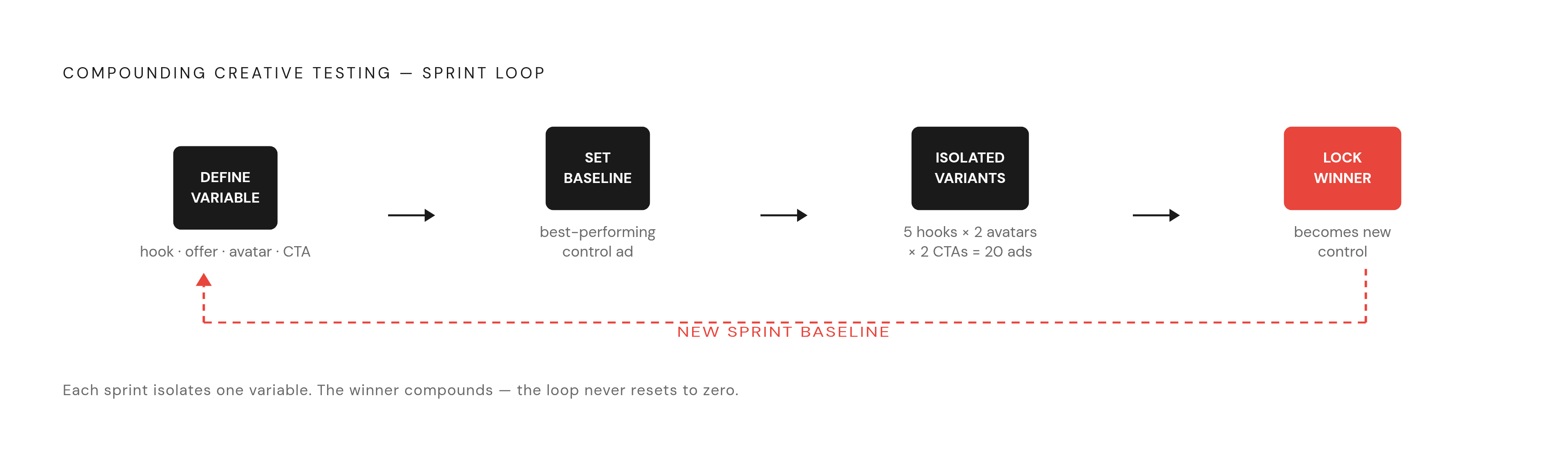
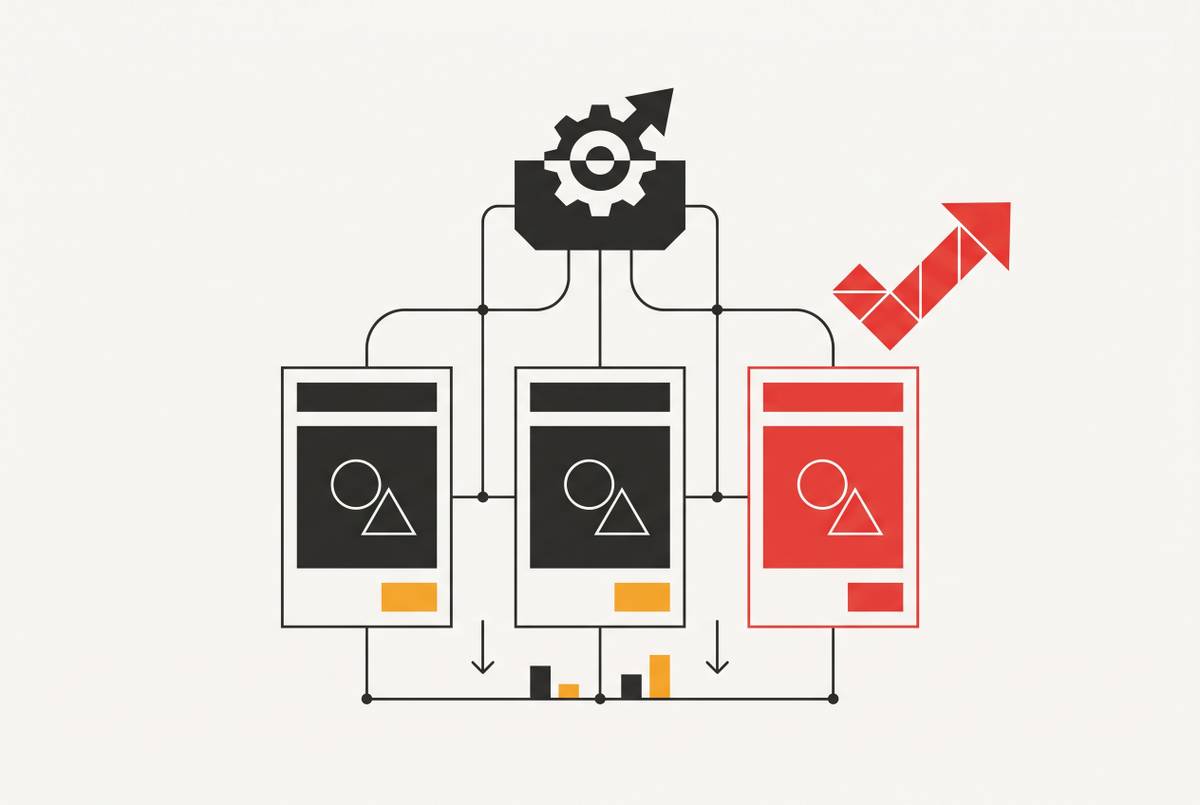
Teams that find winners consistently at high volume aren't generating creative at random: they run a disciplined process where each sprint isolates one variable and feeds its result into the next. The first step is defining what's actually being tested, whether that's the hook, the offer framing, the avatar, or the call to action, and then changing only that one element against a control. From there, a baseline control ad needs to exist before anything else, built from the best-performing creative already running, or, if nothing qualifies, from a simple problem-solution UGC script that gives the test somewhere to start.
The next step is generating variants that isolate the chosen variable cleanly: five hook variations crossed with two avatar types and two calls to action yields twenty combinations from a single working session, and each one needs to be labeled by variable and value in the ad account so the results stay legible later. The hook that wins in sprint one becomes fixed in sprint two, where offer framing becomes the new variable under test, and that compounding is the whole point: creative quality builds sprint over sprint instead of resetting to zero each time.
This discipline pays off because the platforms themselves reward it. Meta's and TikTok's ad systems distribute spend more efficiently when they have a genuine range of creative signals to learn from, not a pile of near-identical variants dressed up as diversity. DTC agency Favoured, working with social media producer George "GG" Gossland, put this into practice by switching to HeyGen for AI UGC production, moving from a turnaround measured in weeks to producing more than 100 UGC-style video ads per week, lifting volume and testing speed at the same time. The framework is what turned that production into something the team actually learned from.
Why Static Brand Guidelines Cannot Serve as Brand Context
A brand guidelines PDF was written for a designer to read and interpret, so it fails as input for an AI system. Brand drift at scale isn't a failure of discipline on the team's part; it's a failure of format. A designer applies judgment to a loose guideline. An AI agent needs something it can apply computationally: design tokens, component libraries, structured metadata, explicit rule logic, the kind of input a system can check against.
Machine-readable brand governance means organizing what a brand knows about itself into formats a system can actually consume, APIs, metadata, JSON, design tokens, taxonomies, permissions, relationships between assets, rather than prose paragraphs describing a visual preference. A simple AI tool and an agent aren't the same thing here. An agent carries context across tasks: it holds onto the brief, the last round of revisions, the guidelines that apply. That makes agents genuinely more useful for complex creative work, but only if the context they're carrying is structured and retrievable rather than buried somewhere in a document nobody has time to reread.
This shift is already visible at the tool level. Adobe GenStudio combines Firefly, including Firefly Custom Models and Firefly Creative Production, with GenStudio for Performance Marketing, Adobe Express, Adobe Workfront, Frame.io, and Experience Manager Assets to manage creative workflows while enforcing brand governance. Firefly's Custom Models feature trains on a brand's own approved assets and visual IP, and that training data functions as the structured brand context the model draws from. Superside's Brand Brain follows the same logic at the agency level: a system built to capture guidelines, tone, messaging, approved creative decisions, feedback patterns, and performance signals, growing more aligned with the brand as each new project runs through it.
Making Brand Context Machine-Readable and Retrievable
Making brand context machine-readable means turning brand identity from something a person consults into something structured and versioned that an AI agent can retrieve, apply, and stay consistent with across every asset it generates. What comes out the other side of that conversion is a set of structured representations: design tokens that define visual parameters precisely, explicit rule logic for tone and voice, and versioned asset libraries an agent can query by attribute.
The governance model that follows from this is risk-calibrated. High-stakes assets still get full human review. High-volume variants get automated brand-consistency checks instead, lowering unchecked drift and the review bottlenecks that would otherwise cancel out the speed AI production was supposed to deliver. Versioning carries the same weight here that it does in software: brand context should update from one canonical source and propagate automatically, rather than leaving five slightly different copies of the guidelines scattered across five people's prompt libraries.
This is already operating at the product level. Knak shipped its MCP Server in April 2026, connecting AI assistants directly to a brand's templates, campaigns, and themes so that output runs through the same rendering pipeline as anything built manually, handling constraints like Outlook compatibility, dark mode, and responsive behavior automatically. Rembrand is testing a Model Context Protocol server for its in-scene ad platform as part of the Ad Context Protocol initiative, aiming to have the protocol generate the creative, recognize the media context, and combine the two into a single unified media buy, treating brand context and placement context alike as structured, retrievable data instead of something a human has to assemble by hand.
MCP Makes Brand Context Accessible to Every Agent
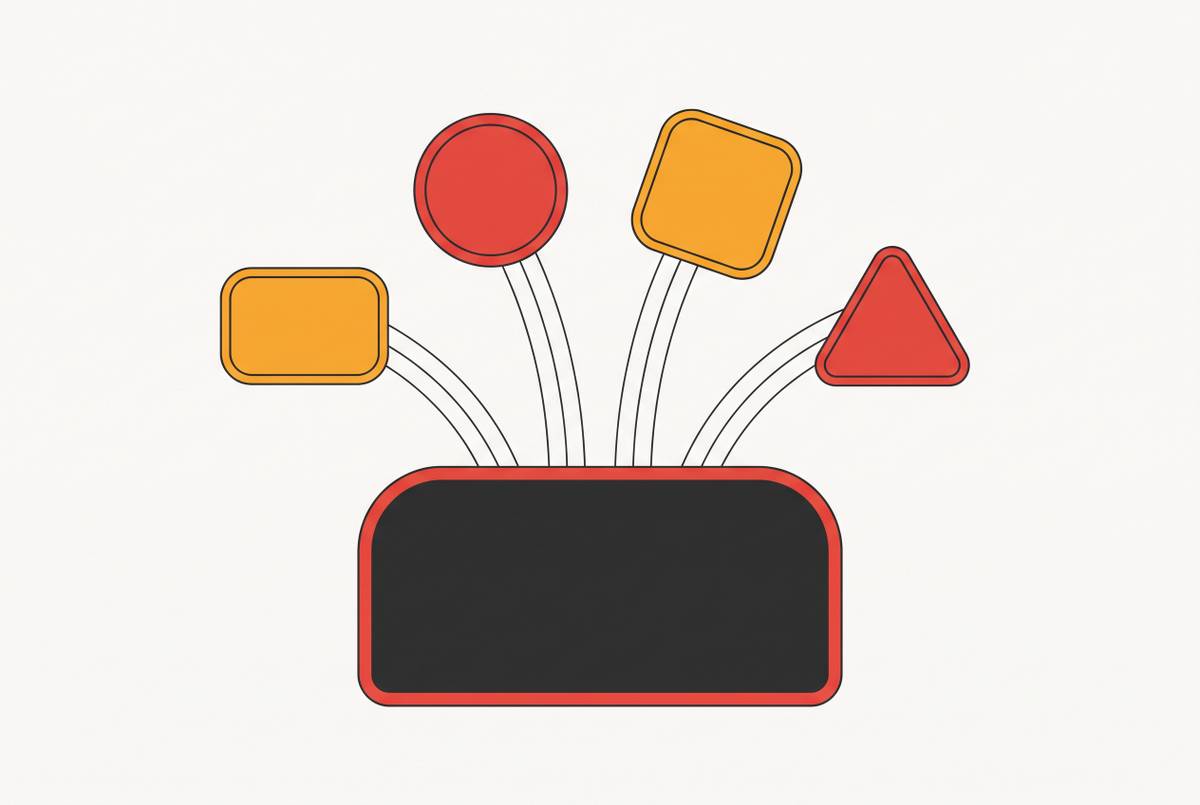
MCP solves a specific, practical problem: instead of pasting the same brand guidelines into every tool separately, a connected protocol gives every agent in a creative workflow access to the same structured brand knowledge through one retrievable interface. For creative production specifically, that cuts out a lot of repeated context-building. Claude can call Higgsfield MCP to generate on-brand images up to 4K resolution and video clips up to 15 seconds, with the prompt, the brand context, and the resulting asset all staying in the same chat thread rather than forcing the operator to reconstruct context every time they switch tools.
Document access follows the same pattern. Notion and Google Drive MCP servers let Claude pull an ICP document, a brand voice profile, or a content calendar by name directly, so you get no copy-paste between browser tabs and no rebuilding context from scratch each session. AdSkate has built an MCP integration so advertisers can test campaign creatives against more than a thousand synthetic audiences through conversational AI, which turns creative iteration into a feedback loop instead of a guessing game and cuts down the uncertainty before a creative ever reaches a real audience.
The structural implication runs through all of it: any brand that organizes its context as an MCP-accessible resource can deliver that same consistent knowledge to Claude, ChatGPT, Cursor, or any other MCP-compatible environment, without having to build and maintain a separate integration for each one.
How Agencies and Enterprise Teams Are Operationalizing This Infrastructure Layer
The teams finding success at real volume have stopped treating brand context as a document to be referenced occasionally and started treating it as a shared service layer every agent and workflow pulls from directly. That shift in infrastructure keeps volume consistent. Publicis Groupe and Serviceplan Group offer the clearest organizational example currently visible: both are deploying Luma Agents, AI collaborators capable of carrying out end-to-end creative work across text, image, video, and audio, across strategy, creative development, and production. Luma Agents coordinate across leading models including Ray3.14, Veo 3, Sora 2, Kling 2.6, Nano Banana Pro, Seedream, GPT Image 1.5, and ElevenLabs, routing each task to whichever model handles it best while holding brand consistency steady across markets.
The role of the creative team inside agencies is shifting with this. The work is less about producing individual assets by hand and more about designing the systems and rules that guide automated production, with brand identity functioning as a rule set that governs workflows. Agency creative infrastructure now typically mixes models by function: Firefly handles brand-safe, production-ready output, OpenAI or Google models handle fast ideation, and specialist models handle narrower tasks, while brand context keeps the final output consistent no matter which model touched which step.
The real edge in 2026 belongs to teams that have closed the loop between production and performance. Most tools stop once they've generated an asset, leaving export, upload, launch, and refresh as manual steps someone still has to run by hand. The teams ahead generate, launch, measure what performed, and then generate the next batch informed directly by that result. Multi-stakeholder approval still sits in front of anything that actually spends money or goes live, and that structure is the direct answer to what happened with Enhance Media Text, where an AI system altered creative without human sign-off. That failure doesn't happen when brand guardrails and approval steps are built into the workflow from the start rather than added on after something has already gone wrong. If an agency manages several clients at once, it needs to treat each brand's context as its own distinct, versioned resource rather than one shared prompt that has to be manually corrected every time a new client's brief comes through.
What brand infrastructure for AI UGC production actually requires teams to build
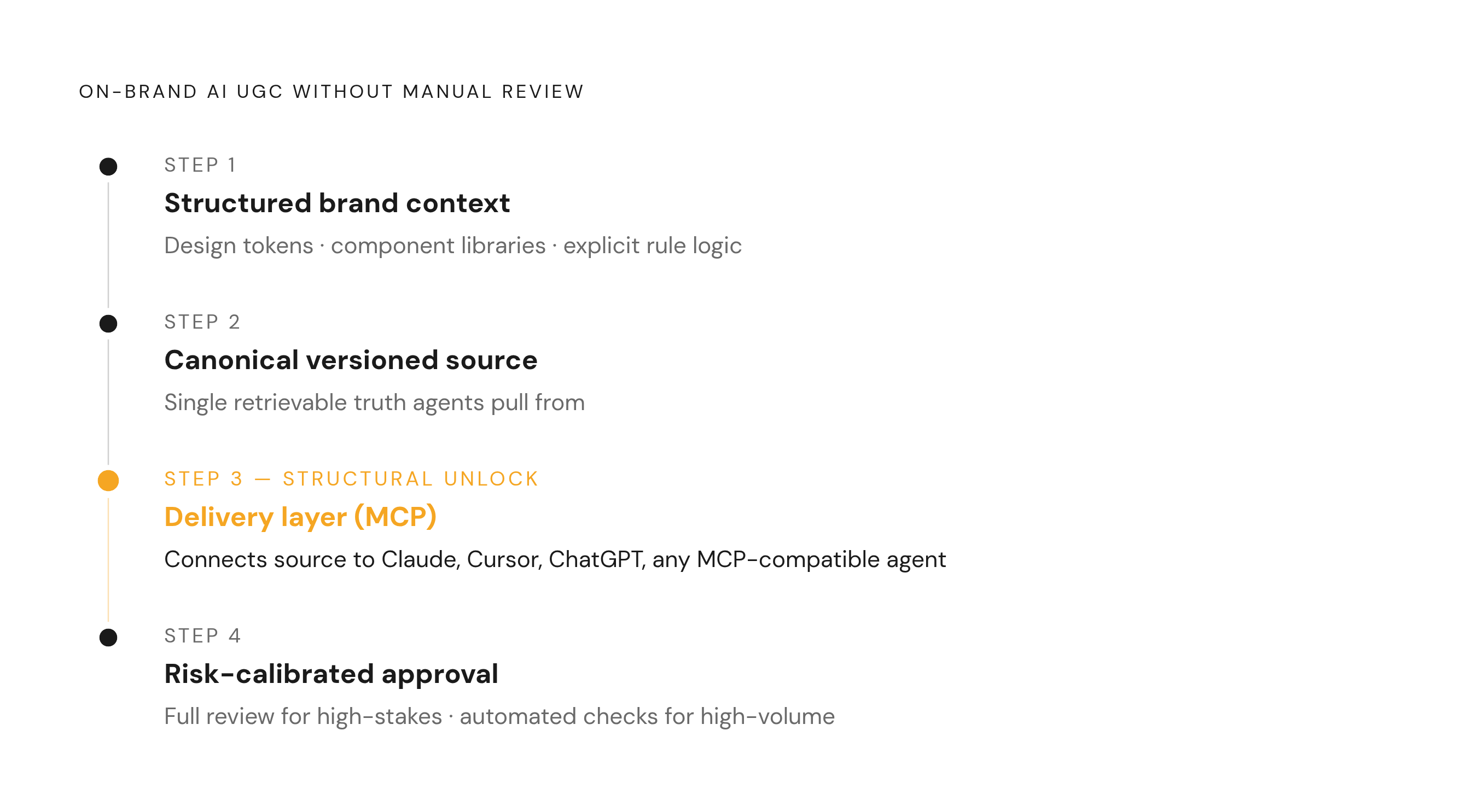
A system where every AI UGC variant stays on-brand without a manual review loop for each one needs four things in place: structured brand context, a canonical versioned source agents can retrieve from, a delivery layer connecting that source to whatever tools are actually in use, and an approval mechanism that scales with risk.
Structured brand context means converting visual guidelines, tone and voice rules, asset libraries, and design system parameters into formats a machine can actually use, design tokens, component libraries, explicit rule logic, giving an AI agent inputs it can apply. The delivery layer is where MCP does its work: a brand's structured knowledge delivered through MCP becomes accessible to Claude, Cursor, ChatGPT, or any other MCP-compatible environment, so the same context reaches every agent in the workflow without a separate integration built for each one.
Rainbrand is built for this exact stack. It ingests a brand's existing assets, guidelines, files, websites, social profiles, design systems, and turns them into what it calls a Brand Skill: a versioned, retrievable representation of the brand's aesthetics, voice, references, and assets that any connected agent or product can pull from through an API or MCP. Teams can manage an unlimited number of brands inside one workspace, and any update to brand context propagates automatically to every downstream system drawing from it, which matters most for agencies and multi-brand operators, where each client's context needs to stand as its own distinct, versioned object rather than a shared prompt someone has to correct by hand on every new brief.
The alternative, every team member pasting brand guidelines into every prompt individually, simply doesn't hold up at the volume competitive paid social now demands. At fifteen to thirty variants a month, per brand, per client, ad-hoc prompt stuffing is a bottleneck, not a workflow.