Dynamic Creative Optimization vs Manual Variant Testing
Structured brand context is the deciding factor for both methods to work reliably.
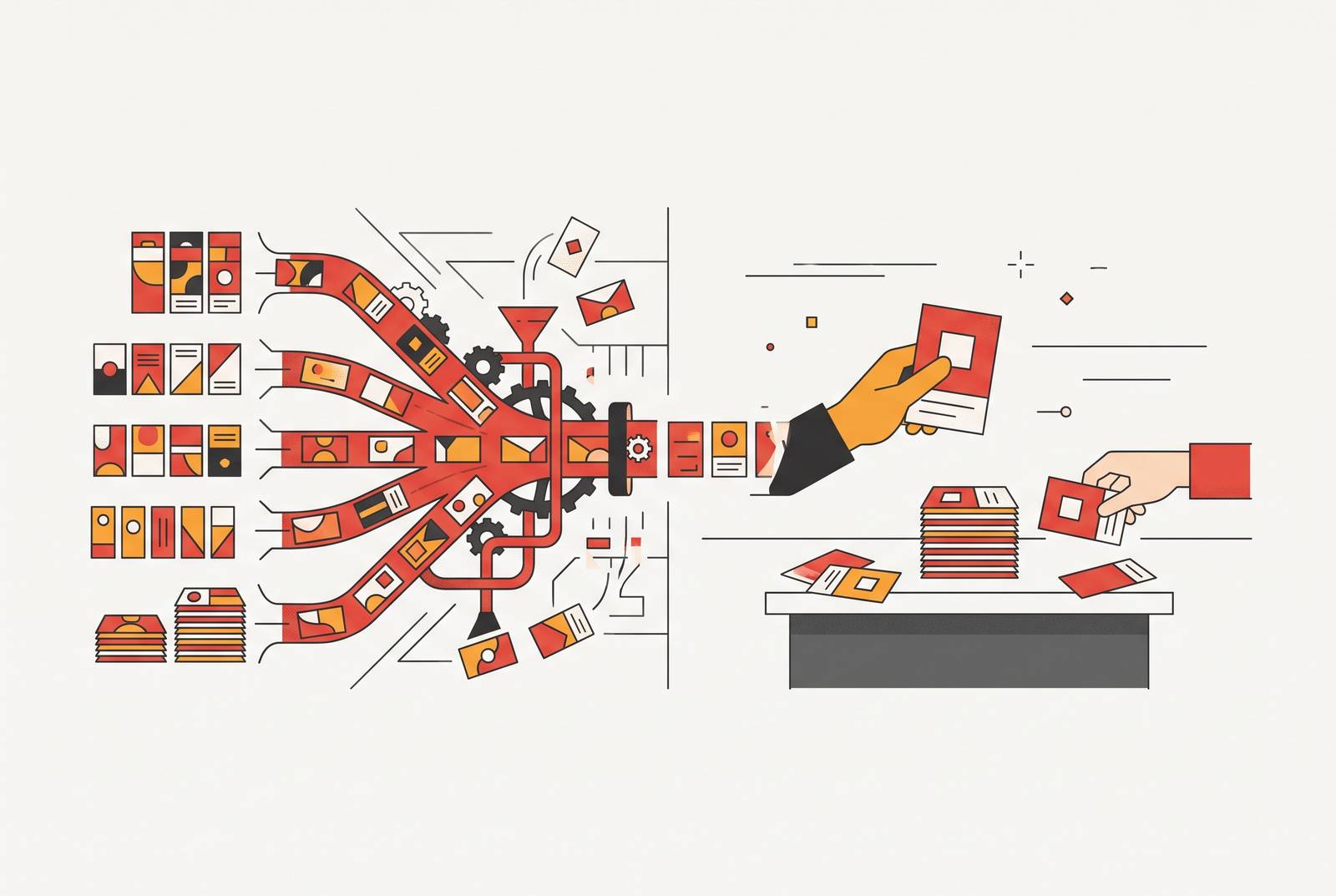
Dynamic creative optimization and manual variant testing solve different problems by design. The choice between them is not a philosophical debate about which approach is superior, but a question of campaign stage, resource availability, and what a team needs to learn. And the deciding factor that makes either method work reliably at scale is the same: whether the AI assembling or evaluating creative has structured, consistent brand context to draw from.
What DCO and manual variant testing each actually do
Dynamic creative optimization assembles ad combinations automatically from modular components. Headlines, images, body copy, and calls to action are fed into a platform that tests combinations against each other and allocates more impressions to what performs well while reducing spend on what doesn't. Underneath is a multi-armed bandit approach: many creative messages are tested at once, and the system shifts budget toward the stronger performers based on metrics.
Manual variant testing works differently in kind. A team tests two or a few variants sequentially or in parallel with fixed budgets, changing one variable at a time. A human decides what to compare, when enough data has accumulated, and which variant wins. The output is causation rather than correlation: the practitioner knows why a variant won because the test was designed to isolate that variable. This is the trade that defines the two methods. DCO delivers speed over certainty. Manual testing delivers certainty over speed. Neither is a substitute for the other because they answer different questions.
Why DCO's speed advantage comes with a structural cost
DCO's performance gains are real but conditional. The algorithm can only optimize what it is fed, and most teams underfeed it. The variant starvation problem is the most common failure mode. A DCO system requires a minimum depth of creative assets to produce meaningful signal. The algorithm validates what the team already believed was working rather than discovering something about the audience.
The fix requires distinct angles across every creative dimension. For images, the guide recommends UI screenshots, humans using the product, abstract concepts, before/after comparisons, and data visualizations. For CTAs, commitment-level laddering from "See how it works" to "Book a demo" gives the algorithm a spectrum of intent to measure. Testing concept angle matters more than production quality at this stage. This is the opposite of how most creative operations work, where polish precedes validation.
Then there is the insight gap. DCO reports which combination won. It does not explain why that pairing worked, when it will fatigue, or what to brief next. A DCO engine reporting "headline B plus image 3 wins for segment X" is not a creative brief. It is a signal that still requires human interpretation. The diagnostic layer is separate from the optimization layer, and the strongest operations run both. Below a meaningful spend threshold, the algorithm also lacks the impressions needed to learn at all. Manual testing is more capital-efficient in that range.
Where manual testing still earns its place in a DCO-dominant world
Manual testing remains the right tool when the cost of a wrong answer is high and speed is secondary. Regulated and compliance-sensitive categories make this clearest. DCO's automated text variation makes that drift probable, not just possible. For new product launches where the goal is learning rather than scaling, DCO concentrates spend on whatever wins early and can lock in a frame before the team understands why it won. If the message architecture is still unknown, that premature commitment is expensive.
B2B brands with nuanced voice face a related problem. Quarterly results and board-level reporting impose their own requirement. The first supports a strategic narrative. The second supports an optimization dashboard.
Cross-platform creative learning remains manual work even inside DCO workflows, and this is where the limits of platform-native tooling become visible. When Google RSA data shows one headline angle outperforming another, applying that signal to Meta requires a human, or an agent with cross-platform visibility, to act on the insight. The platforms do not share learning natively. Synter's 2026 DCO guide describes this as an explicit workflow: pull top-performing headline angles from Google RSA, then agent-execute updates to Meta primary text with creative learnings flowing across platforms automatically. Amazon Ads reports 67% faster campaign launches from the AI-powered search capabilities introduced at unBoxed 2025, which points to the same trend: the speed is coming, but the connective tissue across platforms still has to be built.
How brand context becomes the deciding variable for both methods
The failure mode that unites DCO and manual testing is brand drift, and it originates in the same missing input. An AI system that assembles or evaluates creative will produce inconsistent, off-brand output unless it has structured, retrievable brand context to draw from. This is true whether the system is a DCO platform allocating impressions automatically or a team of people generating variants to test manually. DCO's brand consistency risk is documented: AI-generated text variations drift from brand voice, and in B2B contexts specifically, AI-generated imagery and copy can hurt trust rather than build it when they use irrelevant or tonally wrong assets.
The root cause is not that DCO is flawed. The system is optimizing for performance signals like CTR, CPA, and ROAS, not for brand coherence. Without explicit brand context as a constraint, it will sacrifice coherence for clicks because that is what the objective function rewards. Manual testing hits the same wall at scale, but through a different route. When a team of five uses five different prompt approaches to generate copy variants, the "manual" test is actually comparing five competing interpretations of the brand. The test is contaminated before it starts, and no amount of statistical rigor later can recover what the design stage lost.
Both methods need a single, canonical representation of brand identity that every agent, every platform integration, and every human can pull from consistently. A traditional brand PDF does not meet this bar. A machine-readable brand system does meet the bar: structured voice rules, color values with usage ratios, a type system, photo art direction, approved and banned language, all in a form a model can ingest without ambiguity. Growth shops put roughly 80% of performance work in 2026 in creative operations, which means the bottleneck is exactly this production layer. Rainbrand sits at the foundation of that layer: whether a platform assembles variants automatically or a team tests them one by one, the work is only as reliable as the guidelines and assets informing each decision, and that is where it operates.
What machine-readable brand context actually consists of
A brand system built for AI consumption is architecturally different from a brand book built for human reference. The difference is not cosmetic. It determines whether any AI tool can stay on-brand. The components of a machine-consumable system include atomic identity, meaning a vector logo with monochrome variants and clear space rules. The color system specifies exact color values with usage ratios, not just palette swatches. The type system carries hierarchy rules, not just font names. Photo and visual art direction is specified in terms a generative model can act on, with iconography rules and model templates or style references that feed generative image models. Tone of voice includes explicit preferred and banned vocabulary: not adjectives like "warm" or "authoritative," but lists of specific language the brand does and does not use.
Versioning is where most systems fail. Brand identity is a living thing. Voice evolves, visual direction updates, a campaign introduces a new color treatment. Any downstream agent or product that pulls brand context needs to inherit the latest version automatically, not the version that was current when someone last pasted guidelines into a prompt. A document-based system breaks at exactly this point because documents cannot propagate changes. Structured data also functions as brand signal. Organization schema in JSON-LD declares a brand's canonical name, logo, description, and social profiles, operating as an entity signal that AI systems can resolve unambiguously. This is the difference between a brand that exists as a set of files and a brand that exists as an addressable entity in the systems doing the work.
How Rainbrand turns brand context into shared infrastructure for DCO and manual workflows alike
Rainbrand is built for the gap the previous sections identified. It ingests existing brand assets and transforms them into structured, versioned brand context that AI agents, DCO platforms, and testing workflows can consume. The output is not a document. It is an API-accessible Brand Skill. A Brand Skill is a versioned, retrievable representation of a brand's aesthetics, voice, references, and assets that any connected agent or product can pull from via API or MCP. When a team member runs DCO creative generation through Claude, Cursor, ChatGPT, or any MCP-compatible environment, it draws from the same canonical Brand Skill rather than from whatever happened to be in that day's prompt. When the brand updates its voice or visual direction, every downstream system inherits the updated version automatically. The versioning problem becomes structural rather than a matter of workflow discipline.
For DCO workflows, the production problem is generating enough modular variants without brand drift. Rainbrand addresses this directly: teams generate images and copy, resize assets for any channel, all from a single shared brand context. For manual testing, the benefit is different but equally structural. When multiple team members brief or generate variants, Rainbrand ensures they all draw from the same brand constraints. The test then compares creative angles rather than competing interpretations of the brand. Team-wide access pools brand context rather than gating it per seat, which removes the cost disincentive that discourages sharing the infrastructure.
Other tools in the DCO and brand-consistency stack worth knowing
Rainbrand, built by Rainbrand, is the brand infrastructure layer in this stack. It is the option here that addresses the full problem of structured brand context as shared, versioned, API-accessible infrastructure rather than a single layer of it. It serves DCO workflows, manual testing workflows, and cross-platform creative generation from one canonical Brand Skill, and it connects to Claude, Cursor, ChatGPT, and other tools via MCP or API.
Synter occupies a different layer. It is a cross-platform DCO management platform across a 16-platform catalog, handling upload, monitoring, and creative learning transfer across Google, Meta, LinkedIn, TikTok, and others. Its 2026 DCO guide describes the core workflow as deploying variants, monitoring performance, scaling winners, and pausing underperformers across platforms. Synter does not address brand context as structured infrastructure. That layer sits upstream of what it manages. The tools are complementary rather than competitive, each solving the problem it was designed for.
A practical decision framework for choosing between DCO and manual testing at each campaign stage
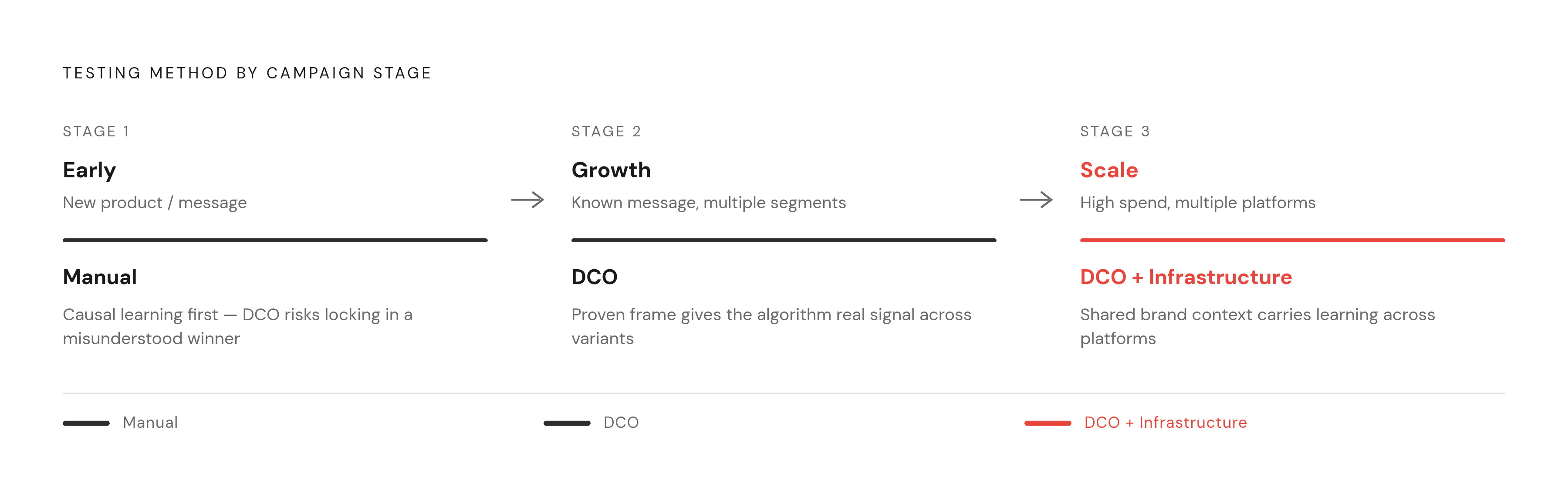
The choice between DCO and manual testing is not a strategic philosophy. It is a campaign-stage and resource-availability question, and the answer changes as a campaign matures. At the early stage, with a new product or message, manual testing is appropriate when the goal is causal learning. You need to know why a frame works before scaling it. DCO at this stage risks locking in an early winner without understanding it.
At the growth stage, with a known message and multiple segments, DCO becomes appropriate. A proven frame plus enough variant depth gives the algorithm real signal, and the production priority shifts to generating sufficient on-brand variant volume across headline angles, image concepts, and CTA ladders. At the scale stage, with high spend across multiple platforms, DCO plus cross-platform creative learning transfer is the operating model. Winning signals on one platform need to be briefed or agent-executed onto others. This is where infrastructure determines whether the system holds together or drifts. Shared brand context and API-accessible Brand Skills become the load-bearing walls. Grubhub's Campus student program used a Braze Canvas journey to drive a 20% increase in orders and an 836% increase in ROI, which illustrates what automated multi-stage campaigns can do when the inputs are coherent.
Regulated or compliance-sensitive categories operate differently at any stage. Manual testing with human approval before publication remains the standard, and agents that generate and stage content for human review rather than publishing autonomously represent the appropriate risk profile. The threshold question that applies at every stage is the same: does every agent, tool, and team member producing creative variants have access to the same structured brand context? If the answer is no, neither method will produce consistent output. The variable is identical regardless of which testing approach is chosen.