Meta Ads Manager Creative Reporting for High-Volume Campaigns
New Meta reporting tools require a specific interpretation order to guide decisions.
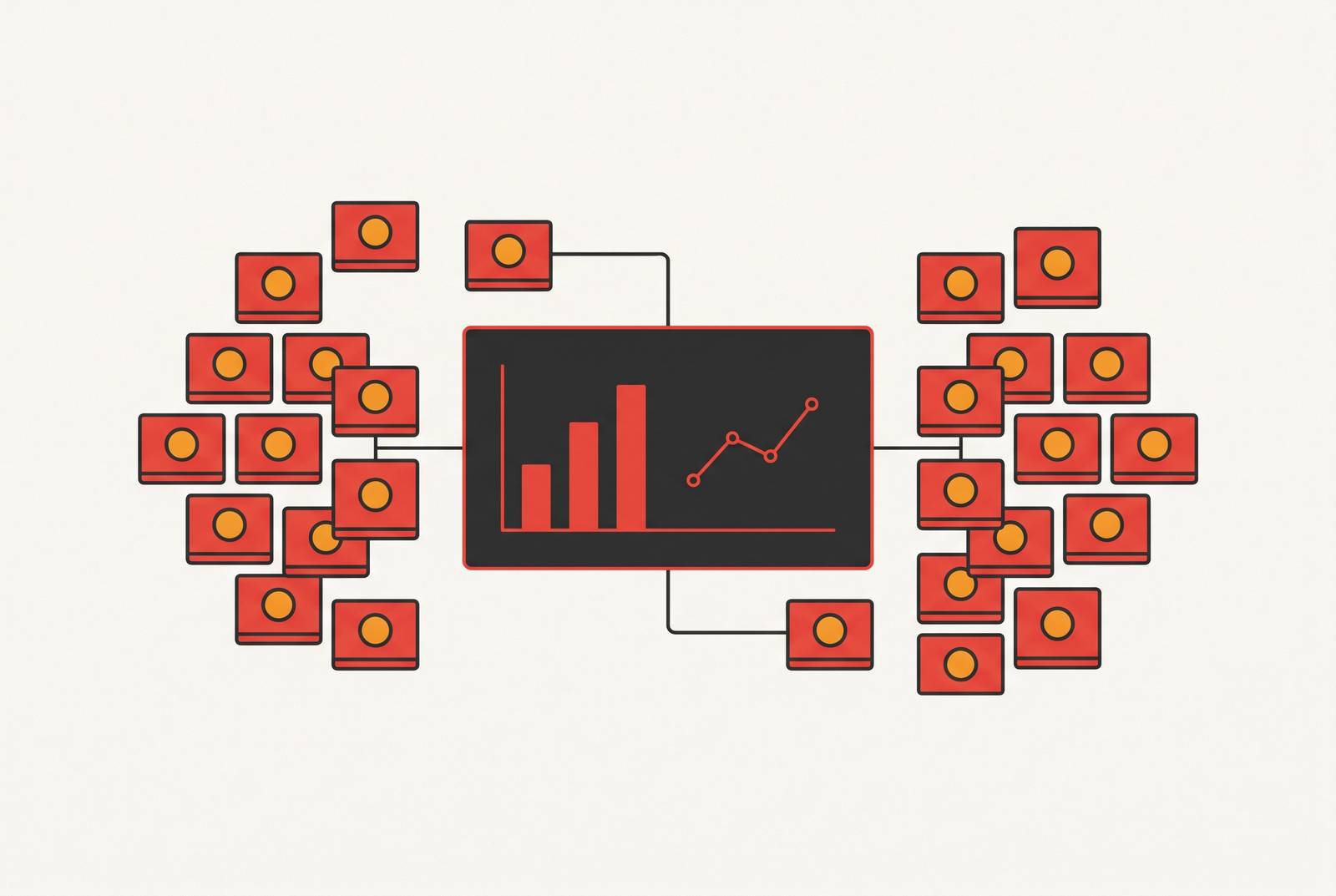
Meta Ads Manager’s creative reporting tools in 2026 expose more of what happens inside high-volume campaigns. Their value depends on the order in which teams interpret them. The practical framework is to inspect creative structure first, diagnose asset performance second, and use automated analysis to cross-check decisions, while a separate brand-context layer governs what production should deliver.
Why creative reporting in Meta Ads Manager now produces more signal than most teams can act on
Creative performance was once largely a black box. Advertisers could see aggregate results without enough visibility into which assets contributed to them. Meta’s 2025–2026 reporting upgrades show more of how creative performs through per-asset breakdowns, Creative Diversity ratings, and AI-generated summaries. The change creates a different operational problem. Teams now have several views of performance, each describing a different part of the delivery process.
A poor cost per result can coexist with repetitive concepts, a weak opening, or an ineffective landing experience, each requiring a different response. At high volume, every additional asset expands the interpretation burden. Visibility therefore does not automatically produce better decisions, because reporting can reveal several weaknesses without establishing which one should be addressed first.
How Andromeda changed what creative reports are actually measuring
Andromeda, Meta’s retrieval system, reads what is in an ad as well as using targeting parameters. Creative therefore helps determine which audiences an ad can reach. Retrieval for a person is a prerequisite for an ad to enter the auction and for its bid to matter. That gate is silent in Ads Manager. Meta deployed its first generative model in ads retrieval in Q2 2026, while upgraded user-understanding models, GEM ranking, and sequence learning drove improvements in Facebook clicks and conversions.
The reporting consequence is more important than the engineering detail. Creative results now provide an indirect view of audience-finding effectiveness. Per-asset reporting can suggest retrieval failure, but it does not directly expose the gate. Poor cost per result may instead originate in engagement or conversion. Interpretation must distinguish insufficient concept diversity from a weak hook or a landing experience that fails to convert traffic.
What the Creative Breakdown actually shows and where it stops
To look at each asset, open Popular breakdowns in the Ads Reporting panel and choose the Creative Breakdown. It works at campaign, ad set, or ad level, with the ad level providing the most useful asset view. Flexible format makes that granularity especially valuable. An ad can contain multiple images or videos, primary text options, headlines, descriptions, and creative groups, while Meta selects the combination for each impression in real time.
Read the resulting table as evidence about the assets within that delivery process. Flexible format campaigns with more than one asset have reported performance gains of 25–40% over single-asset ads in tests run under similar conditions. The breakdown helps identify which assets contributed to those gains. However, because combinations are selected during delivery, an asset row should not be treated as a complete explanation of the result independently of its context.
The limits affect how the evidence can be used. Bar and trend charts are disabled, leaving a table-only view that slows pattern recognition across many assets. Dynamic Creative ads need the Dynamic Creative Element breakdown instead. Creative-level data also covers only campaigns that ran after July 1, 2017. Before drawing a conclusion, check that the chosen report covers the format and time period being reviewed.
Reading the Creative Diversity rating as a structural signal, not a score to optimize
The Creative Diversity rating remains labeled “in development.” It estimates visual diversity across images and videos, but its practical role is to prompt a review of whether an ad set contains genuinely distinct creative ideas. Asset count is not a substitute for that review. Meta groups near-identical ads into a single creative entity, so ten product shots with minor crops and a swapped headline can register together as one creative.
A Low rating on a crowded ad set therefore points toward repetition. The appropriate response is a structural audit of the creative strategy. Frequency provides a related but different view. A Low rating describes what is present in the account, while rising frequency describes what is happening in delivery, so the two need not change together. The rating belongs in diagnosis.
What Meta AI's automated analysis contributes and where human judgment still owns the interpretation
A Monday deck becomes easier to assemble when the assistant can retain context. Meta announced at Advertising Week New York in October 2026 that its business assistant in Ads Manager retains memory of last quarter’s tests, seasonality, and goals, and draws creative insights from Ads Creative Studio. That context makes the summary more useful for finding anomalies.
The document still does not make the decision. Meta’s AI describes Meta’s delivery decisions using Meta’s attribution, so its account of success is not independent evidence. Someone must decide which finding calls for action this week and check that reading against asset-level signals. The summary is therefore useful as an observation layer.
Connecting the assistant also creates a permission decision. The opt-in connection links an AI assistant to an ad account and a Gmail inbox. Meta shipped granular scoping for AI agents in August 2026, including page, Instagram account, business portfolio, and per-ad-account action restrictions. Those controls belong in the connection review before the convenience of automated reporting becomes the default.
The order in which to read the signals: a diagnostic sequence for high-volume campaigns
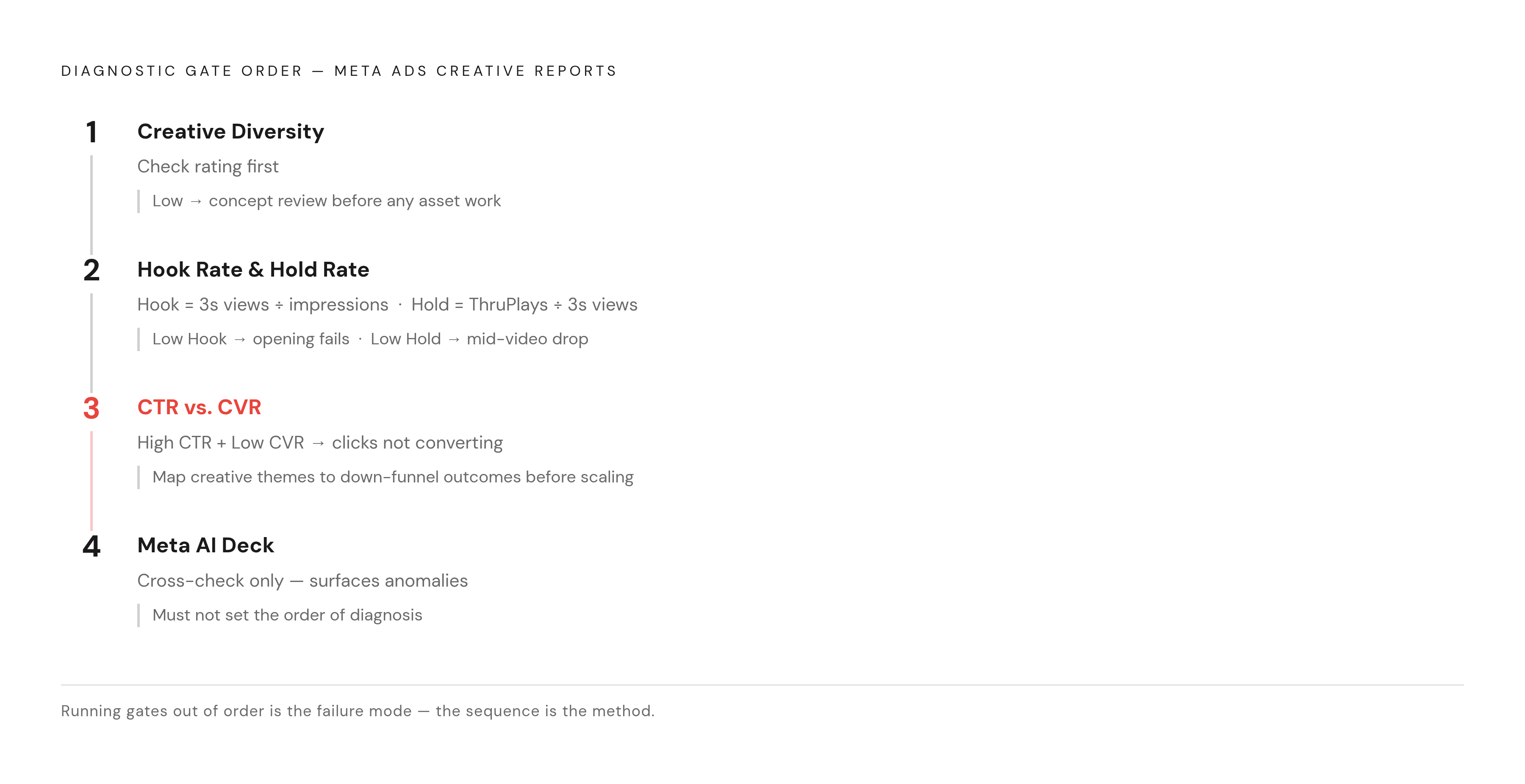
Check the Creative Diversity rating and inspect whether the ad set contains conceptually distinct creative. A Low rating places concept review ahead of asset optimization because repetitive inventory can make individual rows misleading as guides to what the campaign needs next. This is the first diagnostic gate.
Next, open the Creative Breakdown and read the leading indicators before ROAS or cost per result. Hook Rate is 3-second video views divided by impressions, while Hold Rate is ThruPlays divided by 3-second video views. Their order locates the failure. A low Hook Rate points to an opening, concept, or format that does not stop the scroll. A high Hook Rate with low Hold Rate means the opening attracts attention but the body fails to sustain it.
High CTR with low CVR indicates that clicks are not translating into sufficient down-funnel performance, so map creative themes to those outcomes before scaling a top-CTR asset. Attention alone does not establish commercial value. Keep AI-generated assets as a distinct segment as well, using their separate rows under the March 2026 disclosure requirements to compare cost per result with human-produced assets before expanding AI-generated volume.
Finish by reviewing the Meta AI deck. Its proper role here is to cross-check the patterns already identified and surface anything the structured review missed. Although it can provide a first-pass summary, it should not establish the order of diagnosis. Otherwise, the most prominent observation in the document can displace the upstream problem that explains it.
What to pause, what to scale, and what to diagnose further: decision rules at the asset level
Pause an asset with both low Hook Rate and low Hold Rate because it is failing to attract and sustain attention. That stops further budget consumption on an asset the retrieval system is already deprioritizing. The rule is specific to the asset. Overall campaign performance should not obscure failure at both layers.
If Hold Rate declines, preserve the attention-generating concept and test a shorter edit or a different middle section. If Hook Rate is strong but CVR is low, investigate the landing experience. The earlier CTR–CVR cross-check also prevents low-intent traffic from being mistaken for success. Decisions to scale should come after that down-funnel review, including a check of AI-generated against human-produced assets, because a strong attention metric alone is not enough.
Motion’s 2026 Creative Benchmarks places enterprise Health & Wellness first in weekly creative volume, followed by Fitness & Sports and Travel & Hospitality, with Automotive deploying the fewest. Category peers are therefore more useful than a universal volume target. The same benchmarks give text-only ads the highest format hit rate, followed by product images with text, with high-production ads lower. That evidence informs replacement briefs without making production complexity a proxy for likely success.
Why high creative volume creates a brand consistency problem that reporting does not flag
The pause, scale, and diagnose framework answers performance questions. It does not establish whether a successful asset represents the brand correctly. The Creative Breakdown provides no assessment of the correctness of the logo treatment, palette, or voice. AI production makes that blind spot worse when a tool uses its defaults to fill in missing brand context, so the work can become more generic while cost-per-result data stays the same.
That drift has consequences beyond visual preference. A mid-sized tech company’s documented brand drift produced work described as “clean,” “professional,” and increasingly “forgettable,” while sales teams struggled to explain differentiation beyond features and price. Compliance creates a separate exposure. New York’s synthetic performer rule took effect June 9, 2026, with per-violation fines that escalate for repeat offenses and liability for the agency producing the ad. Enterprise brand integrity clauses can also make inconsistent product representation or drifting brand colors an audit failure.
Manual review does not expand at production speed. AI-assisted enterprise production can increase asset volume by an order of magnitude, outpacing the spot-checking practices used for smaller creative batches. A consistency metric makes the gap measurable, but measurement alone does not supply the missing brand rules. Closing that gap requires shared context before production and review against brand evidence afterward.
Making brand context a shared input across every agent that touches creative production
Brand drift often begins with fragmented guidance. When each agent holds its own copy of the rules, pasted into prompts or embedded in separate tools, a brand update must reach every copy manually. Those copies diverge as the brand evolves. Performance reporting cannot repair that input problem because it evaluates results after creative has entered delivery.
MCP is becoming a standard protocol for delivering context to AI agents. Google Ads, Amazon Ads, and Meta Ads all have MCP servers, and the same pattern can support brand context. A single, versioned source delivered over MCP lets connected agents work from the same current guidance. The brief can then specify logo treatment, type, colors, imagery rules, and voice before production.
Finished creative is checked against brand evidence before shipping, with a record of which elements passed and failed. For agencies and multi-brand operators, shared context provides the applicable rules for each brand without rebuilding them per agent or campaign.
Putting the framework into a repeatable weekly cadence
The weekly process needs set thresholds and named people who make the decisions. On Monday, check Creative Diversity across active ad sets and flag Low-rated sets for concept review before looking at each asset. On Wednesday, open the Creative Breakdown, read Hook Rate and Hold Rate, then examine efficiency ratios and the AI-generated asset segment. Apply the pause, scale, or diagnose decision and brief replacements around the concept, format, hook, or body that the evidence identifies.
Use the automated deck after that structured review. Treat any additional pattern as a hypothesis to confirm against breakdown data. This preserves its value as a cross-check without handing it control of the decision sequence. The review ends with actions and owners.
A monthly brand audit runs beside this performance cadence. Score a sample of shipped assets against a rubric covering logo, palette, type, and voice. When conformity falls below the defined threshold, trace the responsible agent or workflow and update its brand context. Manual propagation to every agent does not belong in the weekly process. The cadence governs how teams read signals and act on them, while shared infrastructure keeps the brand guidance behind production current.