The Shared Context Contract Every Agent in Your Creative Stack Must Resolve Before Touching Brand Voice
One authoritative brand source keeps agents from drifting apart.
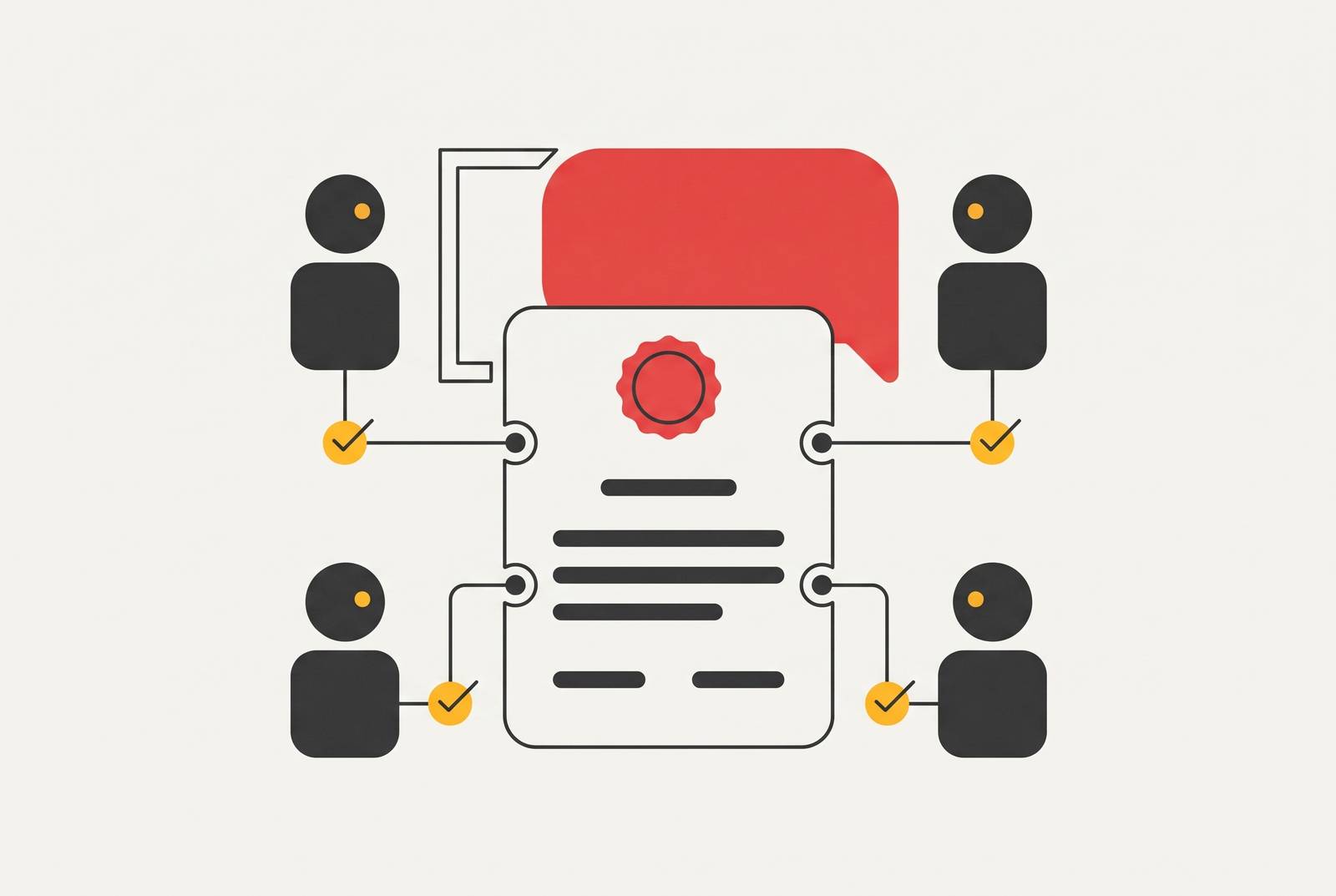
The brand layer for agents is a shared context contract, a single authoritative, machine-queryable source of tone rules, vocabulary, positioning, and channel-specific decisions. Every agent must resolve that contract before it creates brand content. Without it, increasing content volume multiplies independent interpretations of the brand, making drift a structural outcome.
Why brand voice fails at scale even when every individual output looks fine
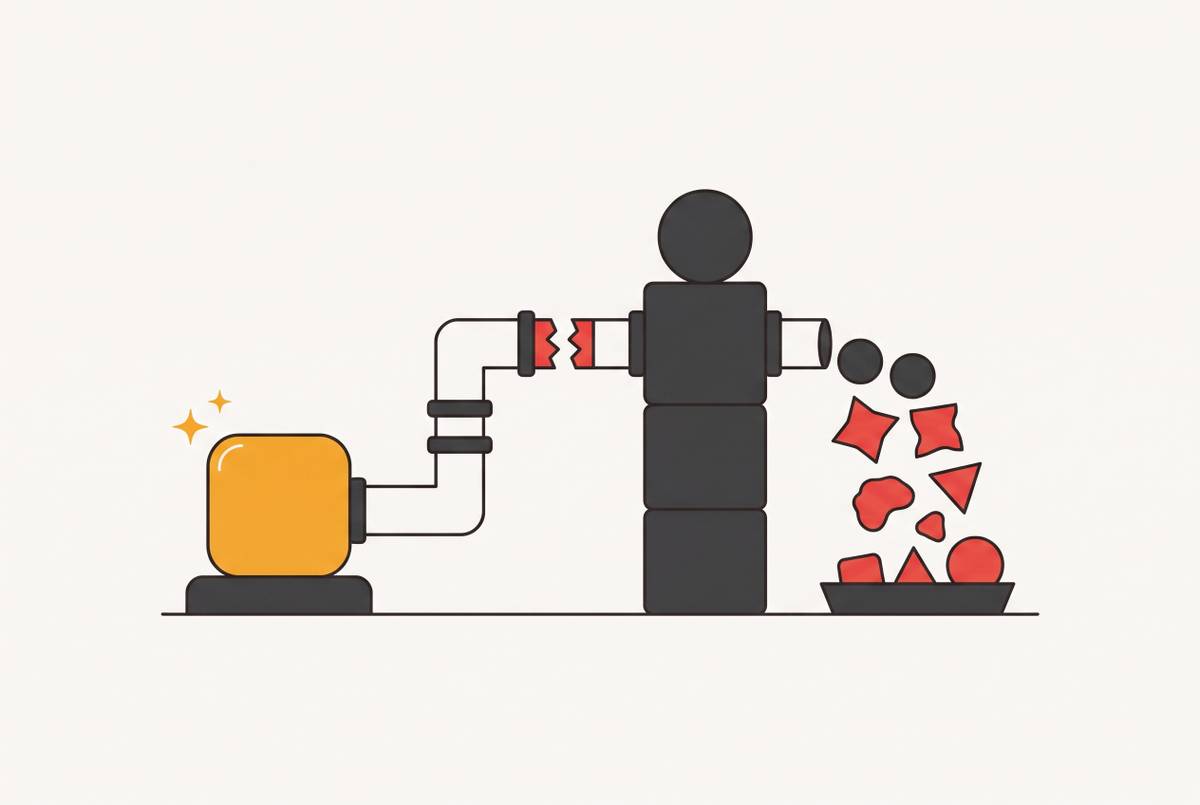
Two competing companies use the same AI tool to draft content on the same topic. The drafts are so similar that swapping their logos changes nothing a reader would notice. Both pieces may be grammatically correct, relevant, and compliant. The failure begins before generation, because the agents receive too little of the context that makes each brand different.
Contentoo’s State of Content Teams 2026 report found that most content teams already use AI often. When those teams rely on the same handful of models, thin brand context leaves shared model defaults to shape their work. Better prompting can improve an individual draft. It cannot, by itself, reconcile fragmented standards, positioning, terminology, examples, and quality signals across an entire creative stack.
Vera V. Vishnyakova’s 2026 paper names three ways this loss happens. Decision Diffusion replaces identity-bearing human choices with autonomous outputs. Temporal Collapse adds to that loss when agents optimize without knowing what the brand has committed to in the past. Accountability Dissolution sustains it when no human owns the cumulative identity pattern. Together, these mechanisms explain how thousands of individually acceptable pieces can become collectively incoherent without any single output triggering an alert.
Why volume turns a context problem into a mathematical certainty
Every new agent or team that contributes adds another place where brand context can have gaps, be out of date, or be read differently. Without a shared source, each of those differences can shape the work on its own. Volume then repeats and compounds their effects. A locally valid decision can recur across many outputs while another agent consistently makes a conflicting choice, leaving the aggregate pattern without a governing reference.
Dust describes a shift from making content in one central team to making it across sales, product, and customer success. That distribution expands the number of context handoffs. For an agency that works with several brands, each handoff also depends on choosing the right client’s rules, regional requirements, and positioning. Context that lives only in a strategist’s memory is at risk when that person is away, even if every agent does its task correctly.
Fixing one prompt at a time cannot keep all of those relationships in check. Senior reviewers also cannot check every draft when output grows faster than headcount. The arithmetic therefore concerns the multiplication of uncontrolled decisions. Governance investment must address the common input. What would it actually mean to solve the problem at its source?
What a shared context contract actually is and what it must contain
A shared context contract sets out the brand decisions that every agent must resolve before it starts work. It includes tone rules, approved and prohibited vocabulary, terminology, permitted claims, positioning boundaries, formatting requirements, and compliance constraints. The channel and audience determine which rules apply. The contract is operational, not merely descriptive. It tells an agent how to choose, rather than leaving each tool to interpret an account of the brand’s personality.
For example, “if channel=LinkedIn, tone=professional” expresses a condition an agent can apply. A general description of a professional but approachable voice leaves more interpretation unresolved. Vocabulary needs explicit constraints on which words the brand uses or refuses, while positioning needs boundaries around what the brand is and is not. Those boundaries also govern adjacent claims. An agent must know which assertions it may make on the brand’s behalf and how those assertions should sound.
The human reference serves a different purpose. A brand book, deck, or PDF preserves nuance and rationale, while a separate machine-readable artifact translates the same strategy into decisions. Vishnyakova defines specification engineering as creating a machine-readable corpus of policies, quality standards, and instructions for coherent multi-agent operation. The brand contract applies that discipline to identity. Vocabulary and compliance can be checked automatically, but taste, ideas, and point of view still require a human owner.
How can multiple AI agents query the same brand context through MCP?
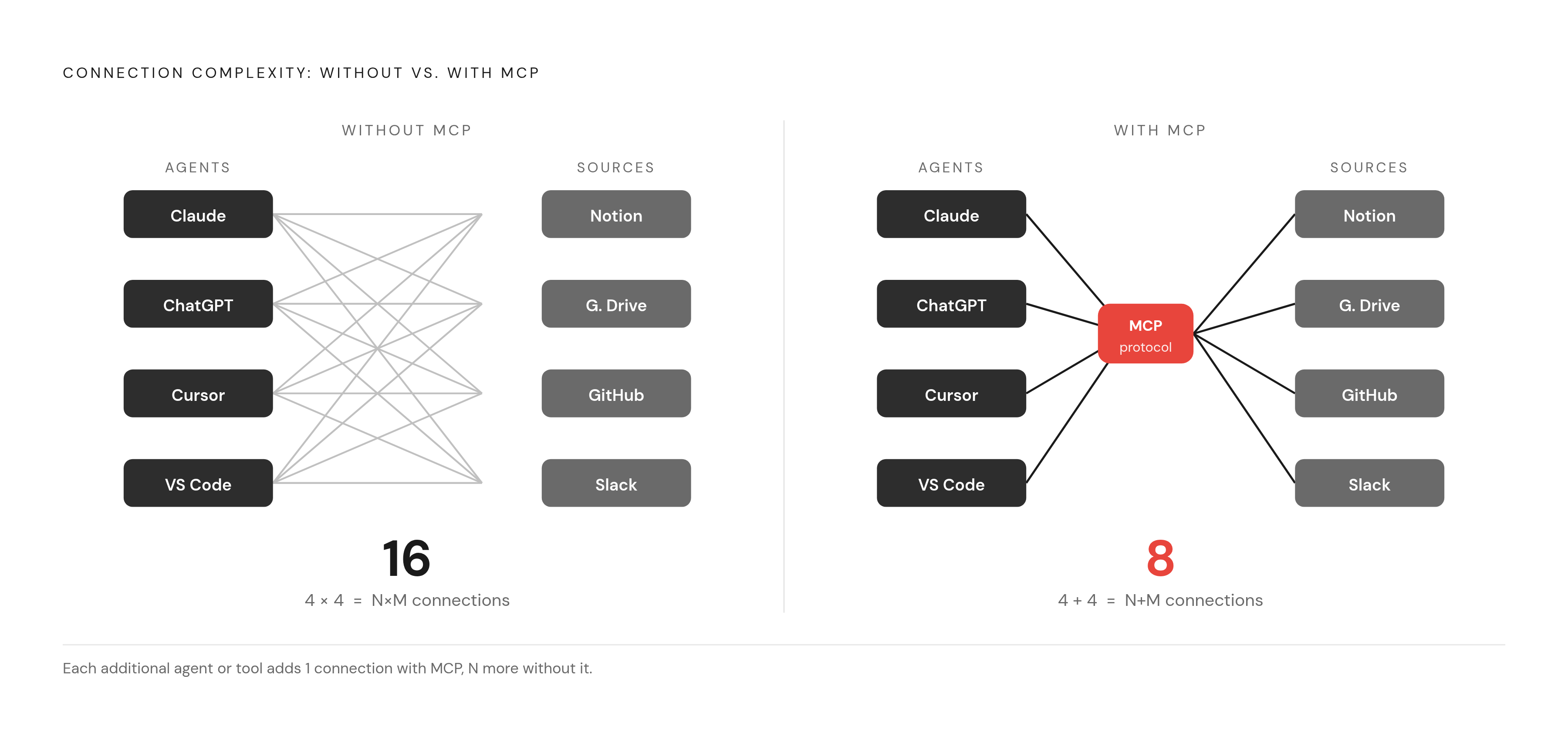
The Model Context Protocol, or MCP, provides a delivery layer for the contract. Instead of maintaining separate copies inside every tool, an MCP server exposes brand context as a live source that compatible agents can query before generation. Freshness is the central benefit of this architecture. A positioning change or new compliance constraint belongs in the authoritative source, rather than in whichever system prompts someone remembers to edit.
MCP also cuts the work needed to connect many agents to many tools. Separate connections use an N×M pattern, while a shared protocol lets them use an N+M architecture. The difference matters more as the number of agents and tools grows. Compatible tools include Claude, ChatGPT, Cursor, and Visual Studio Code, with an ecosystem of servers connecting sources such as Notion and Google Drive to agent workflows. The contract can reach these different tools while keeping the same brand specification in each one.
Vishnyakova notes that MCP governance was donated to the Linux Foundation’s Agentic AI Foundation in December 2025, with backers including OpenAI, Google, Microsoft, AWS, Cloudflare, and Bloomberg. For brand operations, its role is to expose voice rules, visual identity, positioning, and dos-and-don’ts at the point of use. Shared delivery addresses context drift, conflicts, agent silos, and missing freshness guarantees, although update governance must still make that freshness dependable.
File-based standards that make brand context machine-readable at the agent level
File-based standards put the contract into files that projects and design systems can use. AGENTS.md provides project-scoped instructions that agents can read as part of their working context. DESIGN.md is another named artifact for an agent-facing brand specification, while Agent Skills provide reusable instructions across projects. Their scopes differ. Core brand rules belong in the project context, whereas a campaign voice or compliance overlay can be loaded as a Skill only where needed.
The practical maintenance pattern uses AGENTS.md as the canonical source of agent-facing brand context. Tool-specific files, including CLAUDE.md and.cursorrules, then instruct the agent to read that canonical file. One file remains the maintained source of truth. This avoids turning each tool configuration into a separate interpretation of the brand and lets connected tools benefit from the same changes.
A project needs a clear artifact describing its governing rules, while a distributed stack needs a way to resolve the current authoritative context. The distinction is between representation and access. A file can make brand decisions readable to an agent, but its existence alone does not establish that every other agent has received the latest version.
How the shared context architecture plays out in production for a multi-agent creative stack
Dust describes a multiplayer AI workflow in which marketing teams and agents share a content library, brand guidelines, and data sources. Human contributors and agents draw from the same foundation. With that shared input, more departments can make content without marketing having to review every piece. The workflow speeds drafting and reduces independent sources of brand interpretation.
Its customer-story workflow makes that architecture concrete. An agent receives an interview recording, searches past stories for templates and tone examples, and generates a structured draft under the brand guidelines. It then checks voice and style requirements, adapts the story for target markets when needed, and routes it to a human reviewer for final approval. At each step, the agent queries the shared context.
Amazon Ads launched an MCP server in open beta in February 2026, so agents can use natural language prompts to create campaigns and pull performance reports. Early adopters reported substantially faster launches and meaningful weekly savings on reporting and analysis. That deployment demonstrates MCP’s use in campaign operations, though it does not by itself establish brand coherence. To pass the brand-specific test, an agent must resolve the rules that apply before it acts.
For agencies, that test includes keeping the context for each client and region separate. APAC imagery guidelines may differ from what North American rules require, and a UK team may need different compliance language. A shared contract makes those distinctions queryable instead of leaving an account manager as the only source of knowledge during a handoff.
Why static context encoding is not enough and what completes the contract
Static encoding does not solve a changing identity. A contract can accurately describe what a brand says it is while failing to govern the cumulative pattern of what its agents produce. Vishnyakova makes this limitation explicit in the critique of system prompts that specify acceptable language without governing coherence over time. The objection is correct. For shared rules to serve as a complete operating system for brand context, they need versioning, checks on the work, and a named owner.
Versioning gives changes an explicit, documented state. Positioning shifts, campaign language, compliance requirements, and visual identity updates must propagate to every connected agent. The update also needs coordinated semantics. When rules change, propagation must reach all agents before any begins generating from the new state, so that the stack does not operate on conflicting versions. Last-write-wins is not adequate governance for brand identity.
Atlan’s multi-agent context guide treats freshness monitoring as a production requirement for governed business context. A stale approved definition or compliance policy is a governance failure, and its effects may remain undetected at generation and become visible during an audit. Finished work should be checked against the contract with evidence for each check, creating an audit trail that can expose cumulative drift. A named human owner must assess that aggregate pattern, because the contract is infrastructure to operate.
What it takes to make a brand agent-ready: the operational steps
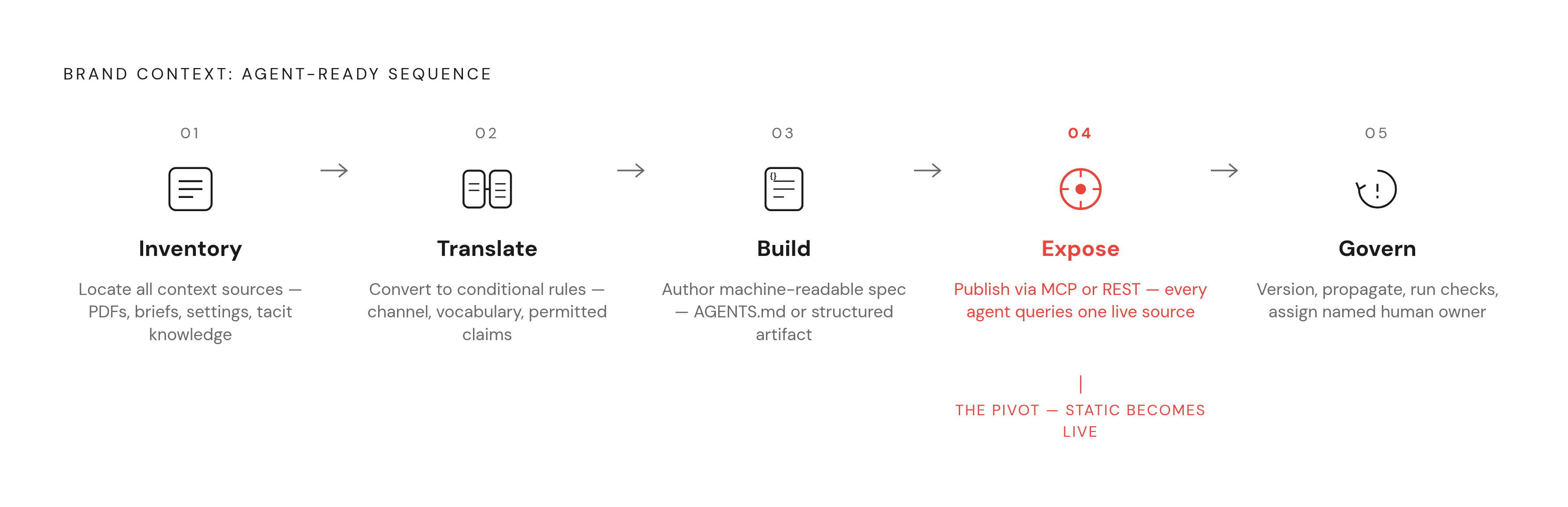
The operational sequence begins with an inventory. A team should locate every place its brand context lives, including PDFs, messaging documents, brief templates, individual tool settings, and people’s knowledge. The purpose is to identify what must be consolidated. For agencies and multi-brand operators, this inventory must preserve the distinctions between brands rather than combine their rules into one undifferentiated source.
Next, the team should translate that knowledge into conditional decisions. Channel rules can specify a professional tone for LinkedIn and a conversational tone for TikTok, while vocabulary becomes explicit allow and block lists. Claims need permitted and prohibited boundaries. From that translation, the team can build a separate machine-readable artifact, such as AGENTS.md, DESIGN.md, or a structured brand specification, while retaining the existing brand book as the human reference for nuance and rationale.
Once the contract exists, it needs queryable access. The team should expose it through MCP so compatible agents resolve the same current context. For teams building their own products, the same context can be accessible through a REST API. Each brand should have its own contract exposed through the shared protocol, so an agent working across clients does not conflate their identities.
The final steps govern change and review. Brand context updates should be versioned, documented, and propagated to every connected agent, without a manual cycle of editing individual system prompts. Before publication, finished work should undergo structured checks against the contract, with evidence supporting each check. A named owner should then review the cumulative pattern those outputs create.