Replacing Per-Agent Brand Prompts With a Shared Context Layer Your Whole Product Team Manages Once
Centralize brand guidelines so every agent follows the same rules.
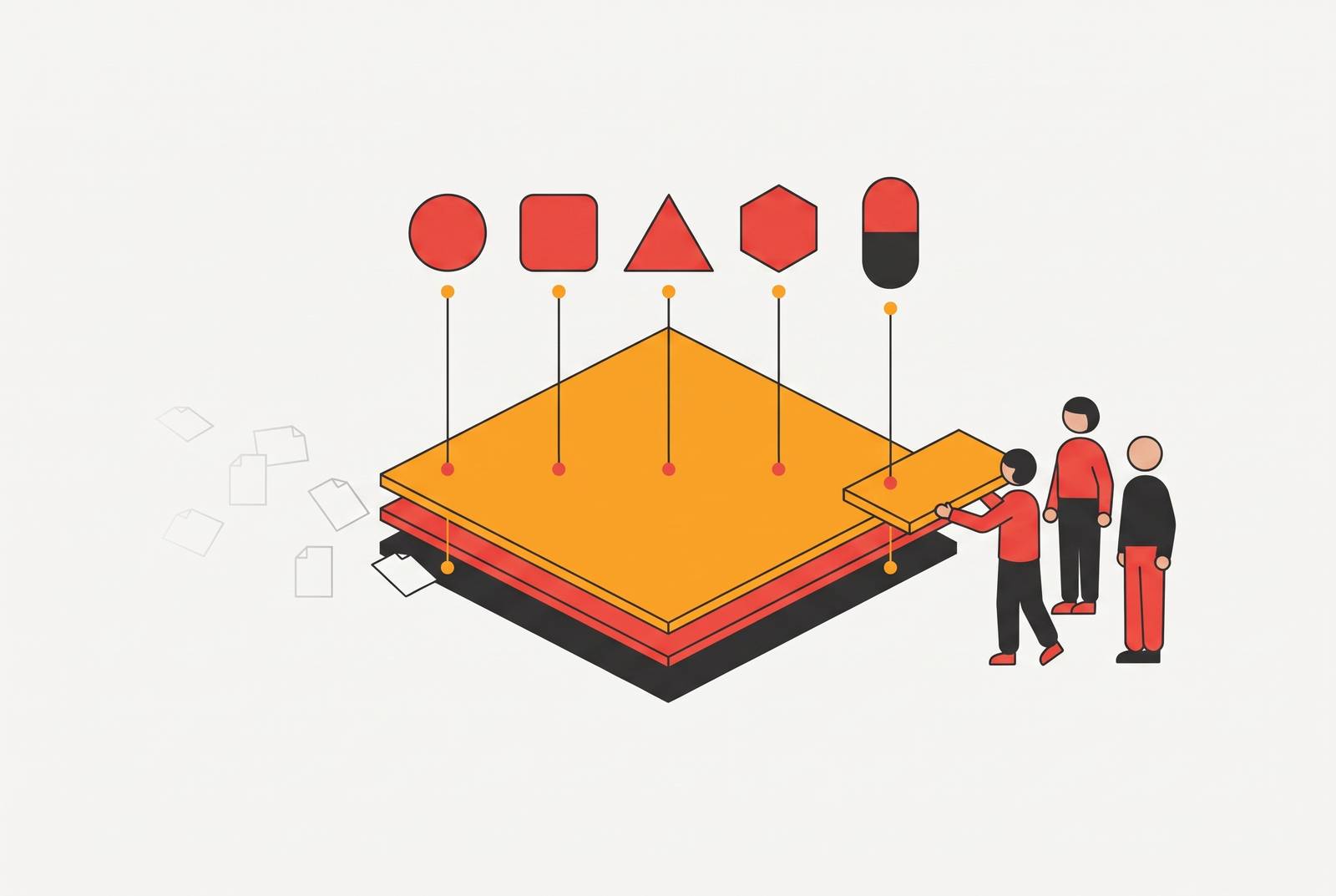
The brand layer for agents is a shared, governed context layer that gives every connected agent access to the same machine-readable brand identity, rules, and decisions. Replacing per-agent brand prompts with this layer fixes an architecture problem. The product team manages brand context once, propagates versioned updates, and reviews generated work against the same specification used to produce it.
Why per-agent brand prompts are an architecture problem, not a prompt quality problem
A marketer pastes brand guidelines into a new system prompt for the fourth time this month. The copy agent already has them, as do the social and email agents, but the image agent needs its own instructions. Each prompt may be written with care and agree with itself throughout. The problem sits outside any individual prompt. Every agent now maintains a private interpretation of an identity that is supposed to be shared.
These private copies create context islands. Two agents can answer the same brand question differently because each has encoded its own version of the rules. A decision made in one agent does not become knowledge available to the others, and an agent added tomorrow starts without the organization’s accumulated context. Better wording can improve a local answer. It cannot create a propagation mechanism between isolated copies.
The mismatch also concerns the form of the source material. A designer can interpret a brand guideline through judgment and experience, while an autonomous agent needs structured tokens, schemas, and rulesets it can act on without a human translator. Repeatedly pasting human-oriented guidance into prompts leaves that translation inside each agent’s boundary. As the stack grows, the team keeps reauthoring definitions.
What a shared context layer actually is, and how it differs from a better-written prompt
A shared context layer sits between the brand’s source of truth and the agents that use it. It translates governed brand meaning into information that any compliant agent can query reliably. The boundary is the defining distinction. A prompt is authored per agent and lives inside that agent, while the context layer is authored per brand and remains outside every agent. Instructions can stay specific to the task while the brand identity stays the same across tools.
Five components give the layer its substance. Semantic definitions establish agreed meanings for brand terms, metrics, and voice rules, while entity resolution identifies the asset, logo variant, or tone register appropriate to a given context. Policy enforcement gives agents rules they must check before they act. Lineage makes the path to an answer traceable, so outputs can be reproduced and reviewed. Memory preserves earlier decisions rather than allowing consistent choices to reset with each session.
A semantic layer standardizes definitions but does not, by itself, settle ownership, freshness, or provenance. A delivery protocol moves context but does not create it. The shared layer combines meaning with governance and continuity. Its value is that it establishes a common reference independent of whichever agent is currently working.
How context islands form and compound as a team's agent stack grows
Atlan’s 2026 multi-agent context guide describes what happened at a global pharmaceutical company when its platforms learned on their own. Different agent tools developed different versions of the truth, and adding platforms worsened the problem. Each platform can know more in detail while still disagreeing with others across the organization. More capable agents do not automatically produce a more coherent stack.
A copy agent and an image agent can receive the same PDF yet encode different priorities, with one emphasizing voice and the other visual rules. Neither knows what the other decided. When a new color system or revised tone arrives, the team must find and update each private copy one by one. There is no shared propagation mechanism or audit trail in that arrangement.
Freshness makes this fragmentation harder to detect. Stale context can produce a plausible answer rather than an immediate error, leaving the wrong decision to surface weeks later when its origin is harder to trace. One agent’s copy may be easy to manage, but five or six agents leave more places where those differences can go unnoticed. Scale accelerates the existing failure. A smaller team with separate copy, social, email, and image platforms has the same weakness in how its tools fit together as the pharmaceutical company.
What it means to make brand identity structured enough for agents to consume it
The practical precondition is to reformat brand identity. A shared document still leaves agents to interpret guidance independently. Machine-consumable identity instead makes assets, constraints, voice, and decisions explicit enough to use within a workflow. The distinction is between description and specification. A brand manager’s work shifts from explaining what the brand should feel like to encoding how that identity governs particular choices.
For visual identity, that specification includes vector logos with approved variations, color palettes in HEX, RGB, CMYK, and Pantone, and typography with approved weights and usage hierarchy. Usage guidance becomes a set of constraints. Logo clear space is a value, minimum size is a threshold, and forbidden combinations form explicit exclusions. These are the existing brand decisions expressed in a form that an agent can apply.
Voice also needs a specification that agents can act on, beyond three adjectives and a paragraph. Sentence-level exemplars and explicit contrasts show which constructions fit, while decision trees identify the register for each channel, prohibited language, and claims requiring legal review. Together, these elements form a machine-readable “brand code” of strategy, customer insights, and business rules. Vera V. Vishnyakova’s 2026 paper defines specification engineering as building a machine-readable corpus of corporate policies and standards that autonomous multi-agent systems can work from. For a brand team, the practical lesson is to treat this schema as a living product specification and revisit it regularly as the identity evolves.
How to give multiple AI agents access to the same brand context through MCP
A centralized specification becomes shared infrastructure only when agents can reach it. Without a standard connection, the team still needs a bespoke integration for each agent-platform pair. The Model Context Protocol, or MCP, standardizes that connection for agents that support it. Its role is delivery. The governed definitions, assets, and policies must already exist in the layer it exposes.
Atlan’s 2026 model-agnostic context guide says this lets MCP-capable agents read the same context unit instead of each learning its own version of the business. The guide also describes how a Fortune 500 retail company chose an open context layer that connects to agents through MCP. That decision rested on the layer’s reach across the stack. The architectural advantage is a common point of access. The team can change the model that uses the layer without having to rebuild the brand knowledge beneath it.
This is also the useful distinction between MCP and a plain API. Function calling wires one model to one tool, while MCP standardizes that wiring across models that adopt it. An API remains a way to connect an agent to shared context. MCP helps when one context layer needs to serve many agents through the same wiring conventions. With either connection method, governance is still needed to decide what the agents get.
How versioning brand context like a codebase solves the update propagation problem
A rebrand, campaign pivot, or legal change tests how well the layer is shared. If some agents receive the change and others continue using older guidance, central storage has not solved propagation. The operational fix is a versioned artifact whose updates reach every connected agent, with the previous version traceable and the current version consistently applied.
A new color system, revised tone register, or updated legal constraint then becomes a versioned change, so the team no longer has to search through system prompts by hand. The analogy to a codebase is useful because it makes changes explicit and preserves their history. Versioning alone is not the whole mechanism. Automatic propagation and freshness monitoring are also required so that agents do not act on superseded governance decisions. The multi-agent guide treats freshness as a production requirement because stale decisions can remain hidden until later audits.
Each output can be linked to the version of context used to make it, so later review can trace what happened. Ownership remains important for the same reason. Context kept in open, versioned formats under the enterprise’s control is not tied to one model vendor’s roadmap. The team can change the model above the layer without surrendering control of the brand definitions below it.
Reviewing AI-generated work against the brand as the final check in a shared-context workflow
AI-generated work should still be reviewed against the brand before it ships. Shared context improves the conditions for generation, but supplying a rule is not the same as establishing that the output followed it. Review closes that gap with evidence. Because the specification is explicit, versioned, and machine-readable, a review pass can check the result against the same reference that guided the agent.
The checks follow the structure of the brand code. Voice can be assessed against sentence-level exemplars and explicit dos and don’ts, rather than only an impression of whether the writing sounds right. Visual checks can compare color use, type hierarchy, and logo treatment with the encoded rules. Policy checks can use the decision trees to check legal claims and restrictions on each channel. A wrong logo variation or a claim requiring legal review becomes a specific finding.
This completes the architectural change introduced by separating brand context from individual prompts. The per-agent prompt model governs generation but supplies no independent review mechanism of its own, because its brand interpretation remains inside the agent. Human review is still possible in that model. What it lacks is a common, independently queryable specification against which generation can be checked at scale. In the shared workflow, the brand layer serves both the agent producing the work and the review assessing it.
What the shared-context architecture looks like in practice for a product team managing it once
For a product team, “managed once” means one governed place to maintain brand identity. The brand team encodes the identity in structured form and assigns owners and access controls to the versioned layer. Agents connect through MCP or an API and query that source. Responsibility remains with the team that owns the brand. The individual agent’s job is to use the shared context for its task.
The operating workflow follows from that division of responsibility. Brand updates are made in the shared layer and propagated as versioned changes, eliminating the need to hunt through each agent’s system prompt. Generated work is then reviewed against the specification used to produce it, with evidence for each check before release. This gives maintenance and review the same reference. The brand team no longer has to act as the manual corrective layer between disconnected interpretations.
Each client has a brand kit encoded once and connected to the shared layer, so assets begin within that client’s brand system. The model scales by adding governed identities. It does not require treating every new agent as a fresh brand onboarding exercise.
In Vishnyakova’s maturity model, context engineering comes after prompt engineering and before intent engineering and specification engineering. The shared brand layer is that second level, establishing the foundation for encoding organizational goals and a broader corporate corpus. Its immediate scope is concrete.